
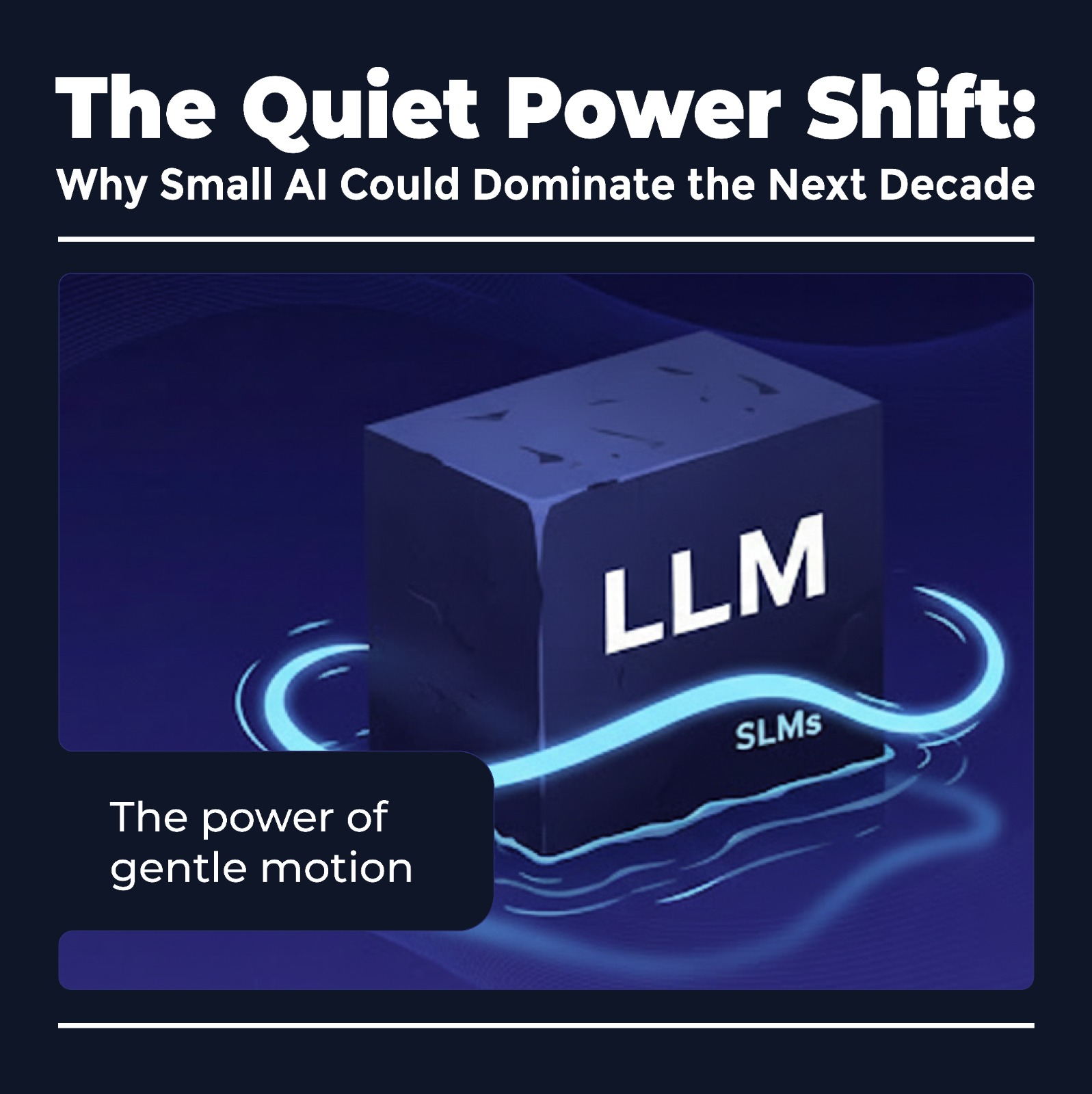
The Quiet Power Shift: Why Small AI Could Dominate the Next Decade
Large Language Models have dominated headlines because of their staggering number of parameters and the uncanny breadth of their capabilities. Yet, beyond the stage lights, Small AI models are building momentum with their ability to deliver with precision. While training, these models use a smaller database and typically employ fewer layers than LLMs, making their architecture more straightforward. They are gaining ground by representing a different philosophy of intelligence: one defined by accessibility, speed, and sustainability.
Enterprises are progressively concentrating on models that prioritize content over size in their pursuit of feasible, sustainable, and cost-effective AI applications. With their unique approach to intelligence development and deployment, Small Language Models are well-positioned to convey this transition.
Challenging the Size Myth in AI
For a long time, the belief in the AI ecosystem was that bigger was always better. Training datasets have grown significantly, infrastructure demands have increased, and the number of parameters has multiplied with each new generation of large language models (LLMs). However, Small Language Models (SLMs) challenge this long-standing assumption that greater size equates to greater intellectual capability. Instead, they embody the concept of purpose-built design, where models are specifically trained and fine-tuned to excel in particular domains.
Small language models (SLMs) often outperform large language models (LLMs) in speed, cost, and customization. Because small language models are built for specific tasks, they need fewer computing resources. This makes them faster to deploy and cheaper to run.
Their focused design helps them process only relevant information. This improves efficiency and avoids unnecessary complexity. As a result, SLMs are less likely to overestimate outcomes. They do not rely on large amounts of irrelevant data. By prioritizing precision over size, small language models offer a practical, efficient alternative to large language models for real-world use cases. Small language models (SLMs) often outperform large language models (LLMs) in speed, cost, and customization. Because small language models are built for specific tasks, they need fewer computing resources. This makes them faster to deploy and cheaper to run.
Small Models, Big Shift
The main advantage of small language models (SLMs) is their practicality and accessibility. Unlike large language models (LLMs), which are complex and require advanced infrastructure, SLMs can run efficiently on consumer devices, local servers, and even mobile phones. (1) This accessibility enables a variety of applications that were previously difficult or impossible to achieve at scale. Examples include personalized healthcare tools for rural clinics, offline AI-powered orthoses in areas with limited connectivity, and streamlined models for Internet of Things (IoT) devices. These use cases highlight where smaller language models (SLMs) are especially effective.
SLMs also deliver faster overall performance. They enable quicker inference, reduce latency, and consume less energy. This speed is critical in scenarios where AI must respond instantly and operate smoothly within ongoing tasks. Moreover, as organizations look for practical ways to adopt AI without high costs or complexity, lightweight models offer a clear path forward. They lower barriers to entry while still delivering meaningful performance.
In addition, SLMs support stronger data security practices. Their smaller size allows them to run efficiently in encrypted cloud computing environments. This makes them easier to deploy and manage, helping to mitigate cybersecurity risks and improve data protection, particularly in sensitive or regulated systems. (2)
Efficiency as Sustainability
From the massive energy requirements to the significant carbon emissions, the environmental footprint of training and running large language models (LLMs) is increasingly hard to ignore. To rephrase, the sheer quantity of electrical energy consumed to train Meta’s Llama 3 was comparable to that consumed by a big aircraft during a seven-hour journey. (3) While their costs extend beyond finances to include planetary sustainability, small language models (SLMs) offer a distinct approach. As a result of their reduced energy usage, SLMs provide a low-emission alternative for businesses seeking to minimize their environmental impact and demonstrate their commitment to sustainability.
To put this in perspective, most large AI systems require powerful servers that consume hundreds or even thousands of watts. By contrast, using just 13 watts shows how dramatically more efficient this approach is. It suggests that advanced language models do not always need massive data centers to function effectively. (4)
As a result, this breakthrough opens the door to running AI on everyday devices, such as laptops, medical equipment, or edge devices in remote locations. It also makes AI more practical in places where electricity is limited or expensive. Moreover, lower power use means reduced operating costs and a smaller environmental footprint, both of which are becoming increasingly important as AI adoption grows. Overall, this development highlights how more innovative hardware and optimized models can make AI more accessible, scalable, and sustainable for real-world use.
To conclude, if the last decade was about building bigger models, the next decade will be about deploying smarter ones. The quiet power shift will not be dramatic; rather, it will be embedding intelligence steadily into everyday systems and devices. Additionally, this will ensure that AI’s potential becomes more than just a news story; it will become a tangible reality for millions of people worldwide.