
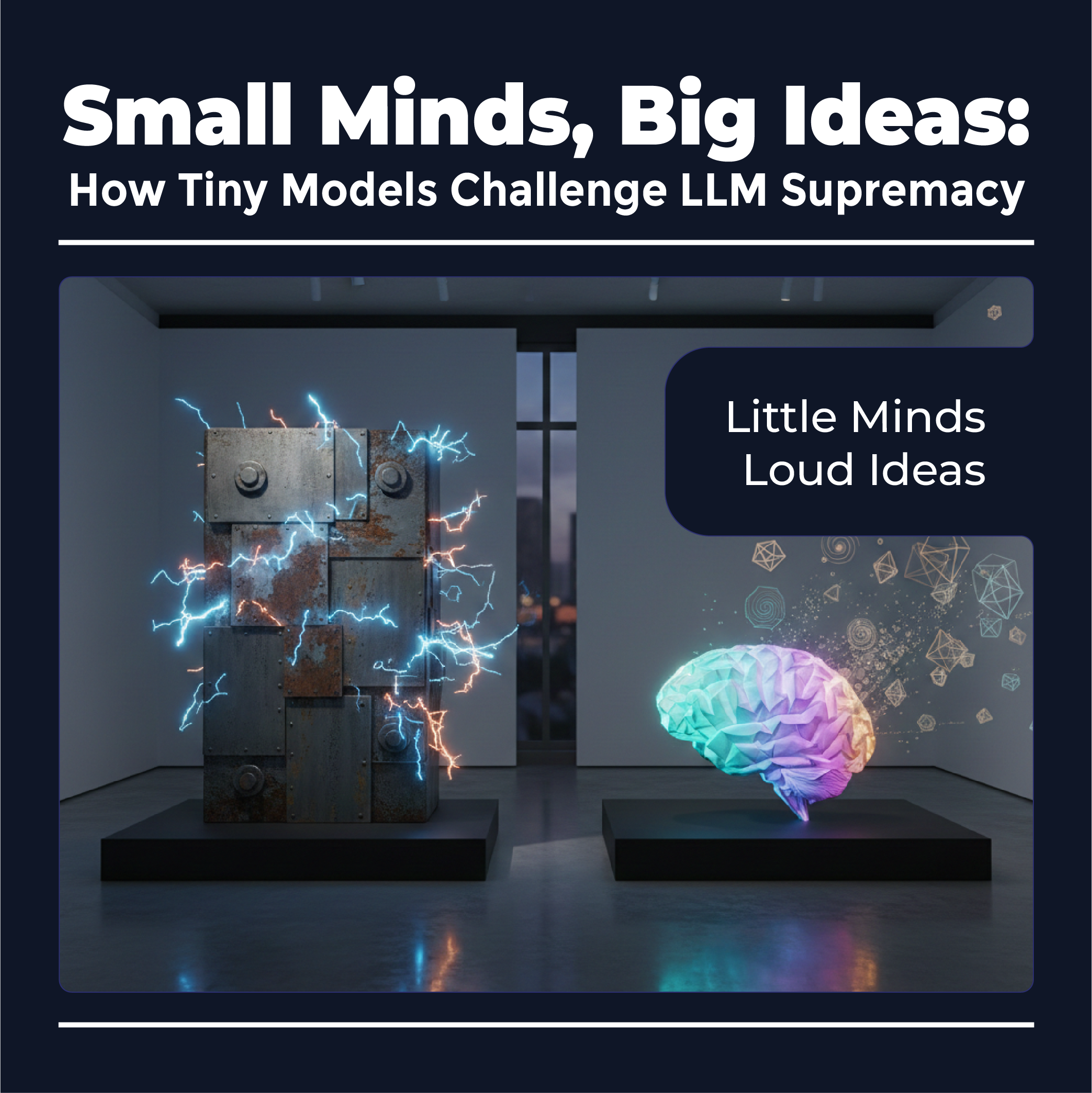
Small Minds, Big Ideas: How Tiny Models Challenge LLM Supremacy
For years, the narrative of artificial language has revolved around going bigger. Large Language Models (LLMs) epitomized this philosophy, showing how scale could unlock remarkable capabilities in Natural Language Processing (NLP). They are versatile and impressive, and they have laid the foundation for AI’s mainstream adoption. Tiny Models vs LLMs highlights a shifting AI landscape in which size no longer determines real-world impact. But not every problem demands a giant.
Enter Small Language Models (SLMs), models that redefine intelligence not by parameter counts but by accessibility and practicality. These models are dominating headlines, shaping corporate strategy, and fueling debates about the future of technology. SLMs demonstrate that smaller models, when carefully optimized, can deliver precise, faster, and accurate results where intelligence is actually necessary.
LLMs gained prominence by mirroring human qualities and by conversing across countless domains, scaling neural networks to unprecedented levels. Yet their dominance comes with costs. The management and training of LLMs require enormous computing infrastructure, numerous datasets, and energy budgets that raise sustainability concerns. These models present a plethora of challenges when interfacing with the underlying algorithms and their outputs.(1)When dealing with large amounts of data, autoregressive models can be complex to infer, as they synthesize text token by token, raising privacy concerns when using third-party cloud computing services. (2)
Small Language Models (SLMs) like DistilBERT, Gemma, and Granite highlight a shift in this AI thinking. These are compact alternatives designed to focus more on optimization rather than expansion. Techniques such as removing redundant parameters without harming the model (Pruning) and compressing models for lighter storage and faster execution (Quantization) make SLMs leaner and easier to deploy. Because of their compact nature, SLMs can operate on edge devices or local devices. Projects requiring categories where data security is paramount, such as healthcare and banking, benefit substantially from this capacity. Tiny Models vs LLMs explains why efficiency, privacy, and edge deployment favor compact AI systems. (3)(4)
Innovation does not always require expansion; it can also indicate learning how to do more with less.
SLMs can function on edge devices or modest cloud infrastructure, unlike LLMs, which require enterprise-scale budgets and specialized hardware. Moreover, their reduced footprint makes them ideal for local deployment. For example, consider a mobile app that can translate languages or recognize voices even when in airplane mode, all powered by artificial intelligence, and you are unlikely to require an internet connection or stable servers. Moreover, SLMs can be enhanced to mitigate bias in the training data by restricting training to carefully selected datasets. This is particularly crucial in sensitive domains such as defense or law enforcement, where biased results could have serious practical consequences. It helps minimize the need for constant cloud usage and lowers both operational cost and energy demands. (5)
Additionally, they are easier to fine-tune for specialized tasks. For instance, domain-trained SLMs provide compliance checks and fraud detection without exposing sensitive data to external servers, and hospitals and clinics can run SLMs locally, ensuring patient privacy while supporting tasks like triage, report generation, and decision support.
The future of artificial intelligence, therefore, resides in a balanced ecosystem. LLMs will continue to excel in scenarios demanding extensive knowledge and complex problem-solving. Simultaneously, SLMs will carve out a niche in applications where efficiency, accessibility, and targeted expertise are critical. This harmonious coexistence of scale and simplicity will ultimately drive the evolution of AI, ensuring that the right tool is available for the right task, thereby maximizing the impact of artificial intelligence across a diverse range of applications.