
Every Label Has a Story: Digital Fingerprinting and the Rise of Authentic Packaging
In an era where counterfeits slip seamlessly into global supply chains, trust is encoded in microscopic codes on a package. Through digital fingerprinting, every microscopic code becomes a unique texture or data with an impossible-to-replicate yet easily identifiable marker. Counterfeit goods no longer hide in black markets; instead, they infiltrate diverse e-commerce platforms, offering everything from fake pharmaceuticals to fragile automotive parts. In this landscape, brands cannot treat trust as a surface feature; they must embed it into every aspect of the packaging.
What if every goods package had a unique, unchangeable digital ID that could be verified? Digital fingerprinting comes in. Counterfeiting is a growing problem for the global economy.
Experts at Corsearch estimate that fake goods made up 3.3% of all worldwide trade in 2023. This number is expected to climb, potentially reaching 5% by the year 2030. (1)
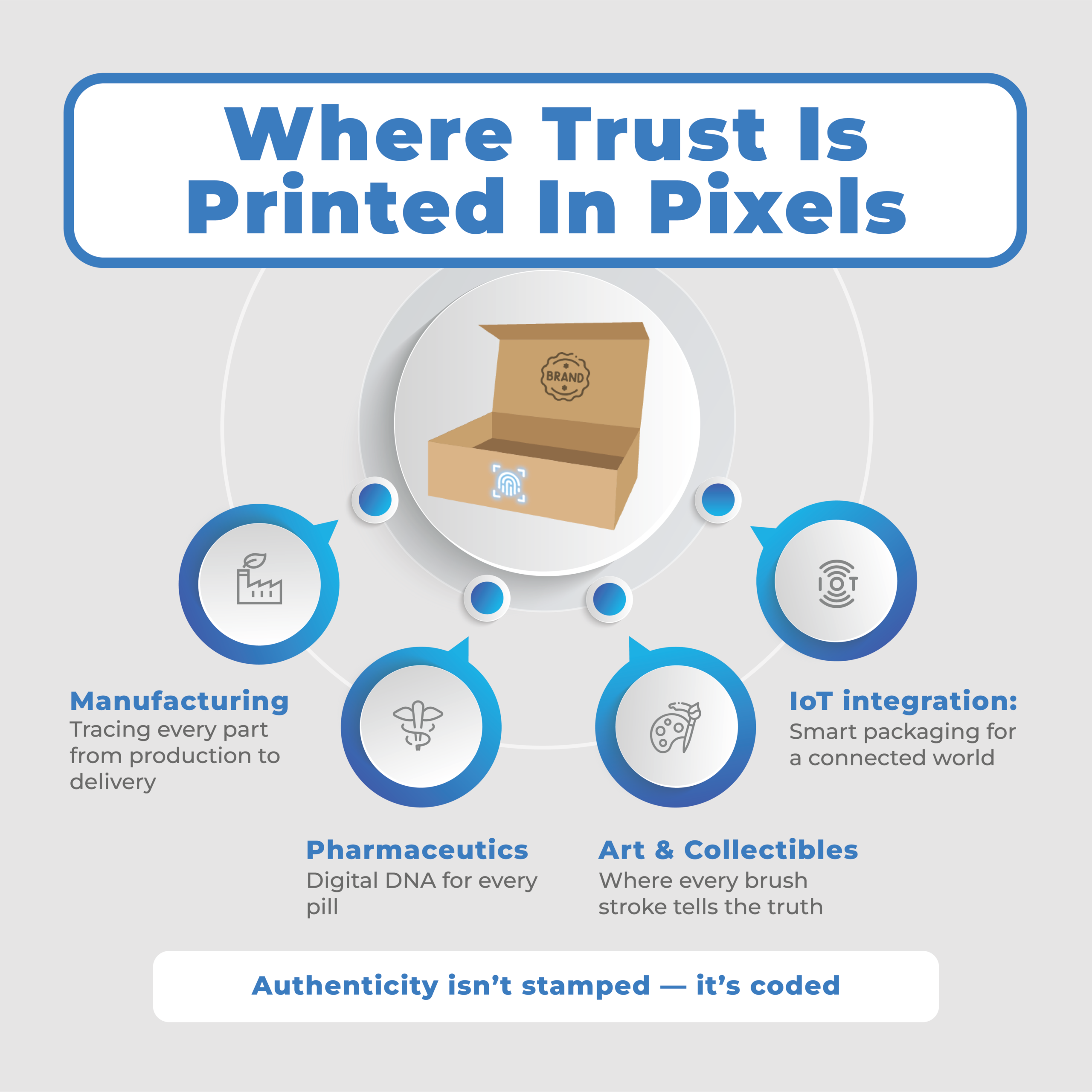
These patterns, invisible to the human eye but discernible to a computer, comprise a product’s DNA. Furthermore, failing to adequately verify the legitimacy of brake pads, bearings, or electronic components can compromise safety. Implementing digital fingerprints or safety precautions establishes a transparent layer of authenticity throughout the product’s manufacturing process.
Yvette Orozco hinted in the “Houston Chronicle” that 90% of counterfeit products, including fake Apple chargers, were produced in China and Hong Kong. (2) This dominance in the illicit market extends into the high-tech sector, where fake Apple chargers have become a primary concern for both law enforcement and consumer advocacy groups. Brand owners are increasingly adopting counterfeit-detecting digital fingerprints to turn standard labels into unhackable security assets. Unregulated facilities often manufacture these “knock-off” electronics in sophisticated settings. Beyond the economic damage caused by brand dilution and lost revenue, Orozco’s findings point to a significant public safety risk. Unlike genuine Apple products, these counterfeits frequently bypass rigorous quality control tests, leading to hazardous failures such as electric shocks, overheating, and house fires.
Counterfeit medicines, on the other hand, pose not only an economic threat but also a significant public health concern. Digital fingerprinting ensures that every vial, blister pack, or bottle has an unalterable identity. As reported by Reuters, approximately 10% of medications in low- and middle-income nations are counterfeit, contributing to a staggering annual death toll of 1 million people globally. (3) Despite significant progress in the pharmaceutical sector, in developing countries like Bangladesh, up to 20%–40% of the medications available in the local market may be counterfeit or substandard. A report by “Daily Observer” highlights that annual sales attributed to counterfeit medications reach a staggering Tk 1,500 crore. (4)
If every brush stroke, canvas, or frame could carry an unforgeable digital fingerprint, would the authenticity in art take a leap from subjective opinion to technological truth? Italian authorities recently uncovered a massive forgery network spanning Europe. They seized counterfeit artworks worth about €200 million (roughly $212 million). These fake pieces were sold as original works by famous artists like Picasso, Banksy, and Warhol. The fraudulent operation involved people from Italy, Spain, France, and Belgium, according to The Guardian. (5) Embedding microchips into products or machinery enables automatic registration with a cloud service. This capability supports validation throughout the global distribution channel, enabling users to check service warranty status and verify device compatibility.
Biometric scanning is growing fast across many industries. Now, we are seeing the rise of a single, unified system to verify authenticity. This new infrastructure acts as a secure home for data. It allows digital fingerprints from different sectors to come together in one place. As a result, we are creating a universal standard of trust for everyone. In this new era, checking for fakes will be very simple. It will be as fast as scanning a barcode at a grocery store. This technology ensures that authentic products are no longer a luxury. Instead, safety and truth become a shared resource for all consumers. Eventually, proving a product’s origin will be essential. It will be just as important to our daily lives as the internet or electricity.