
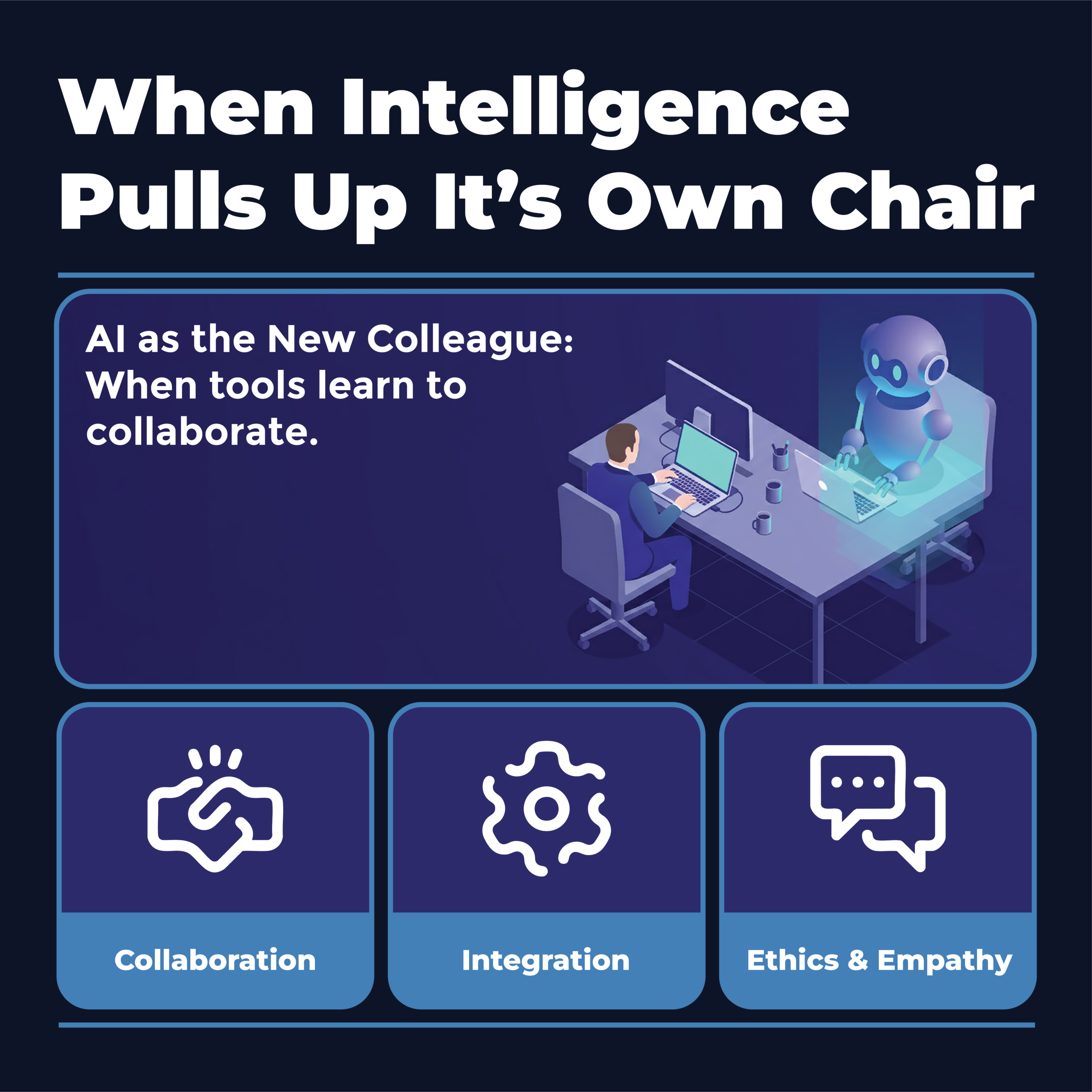
AI as the New Colleague: When a tool becomes a co-worker
Imagine walking into your office and finding your colleague who never sleeps, never misses a deadline, and can analyze years’ worth of calculations in a jiffy. We call him “AI,” and he is not human. Artificial Intelligence (AI) is always on the move from the sidelines to the centre of collaboration. We can seldom use it as a passive tool when it’s actively creating, collaborating, and challenging humans in ways that were unimaginable once. In today’s fast-evolving workplace, AI as the new colleague is no longer a futuristic concept but a practical reality. The transition from tools to companions has impacted not only operations but also the broader culture of work.
Your next co-worker might not drink coffee, but can draft your reports in seconds.
Companies are exploring how AI as the new colleague can handle repetitive tasks. This allows human employees to focus on creative problem-solving. The main strength of AI is its ability to read and understand large documents. It can process and analyze information much faster than a person. The transformation of these applications is subtle but profound. They are integrated deep into our workflows, offering instant analytics, generating drafts, and suggesting innovative ideas. A few years ago, AI platforms like Jasper AI, Midjourney, or ChatGPT were like quiet interns. Today, they are full team members. Using AI in daily work is a new kind of teamwork. Human intuition, ethics, and empathy, combined with AI’s data and pattern recognition, create a new way of working. Humans and technology are now working hand in hand.
According to a commentary in “Fortune,” technological advancements in LLMs’ natural language processing capabilities have paved the way for the emergence of hybrid workforces, in which humans can engage with AI agents in a manner analogous to human teammates. (1) Even with more conceptual inputs, your AI colleague can still formulate and carry out a strategy, returning for further assistance as required. Today, humans can collaborate with AI agents just like they do with human teammates, creating a hybrid workforce. Even with broad or conceptual tasks, an AI colleague can make a plan. It can take action and come back for guidance. This makes teamwork faster and more efficient. Humans bring creativity and decision-making. AI adds speed, accuracy, and analysis. Together, AI, as the new colleague, becomes a trusted partner in achieving complex goals.
However, this shift and evolution come with challenges. AI cannot be held liable for trust, transparency, and accountability, unlike a human teammate. In the not-too-distant future, as predicted by “Anthropic” CEO Dario Amodei, AI will surpass human performance in nearly every domain. Furthermore, to streamline government operations, Elon Musk’s “Department of Government Efficiency” (Doge) has proposed replacing human employees with virtual assistants. (2) On the contrary, in the article “Artificial Empathy: Is It Still Empathy?”, Sara Gibbon underscores the fact that empathy in AI is manufactured, emphasizing that artificial empathy is less valuable than human empathy. However, from Jakob Nielsen’s perspective, what truly matters is the impact on the recipient, not the generation. (3)
For instance, multinational companies like IBM collaborate with AI-driven Watson to enhance customer services and optimize supply chains. Even in healthcare, according to the World Economic Forum, AI has the potential to eliminate the accessibility barrier that currently affects 4.5 billion people. For now, artificial intelligence is assisting medical professionals in assessing patients, detecting fractures, and identifying early signs of illness. Embracing AI as the new colleague requires redefining roles, collaboration methods, and performance metrics in modern teams. Using AI, institutions can streamline operations, implement quickly, and provide superior support, all of which could put them ahead of competitors. (4) Artificial intelligence (AI) is rapidly becoming an important factor in the growing popularity and improvement of the financial services sector. Innovations in AI are reshaping the banking and trading industries by enabling faster, more intelligent, and more adaptable solutions. (5)
AI as the new colleague is no longer a concept from science fiction; it is becoming our next brainstorming partner and creative collaborator. By working thoughtfully alongside AI, humans can amplify their strategic vision, generate deeper insights, and enhance overall creativity. Instead of replacing employees, AI, as a new colleague, complements human skills by handling repetitive tasks, analyzing complex data, and suggesting innovative solutions. In the near future, AI won’t take your seat at the table; it will pull up its own chair, contributing to a hybrid workforce where humans and machines achieve more together. Embracing AI as a new colleague allows organizations to unlock new levels of productivity, collaboration, and innovation in every project.