
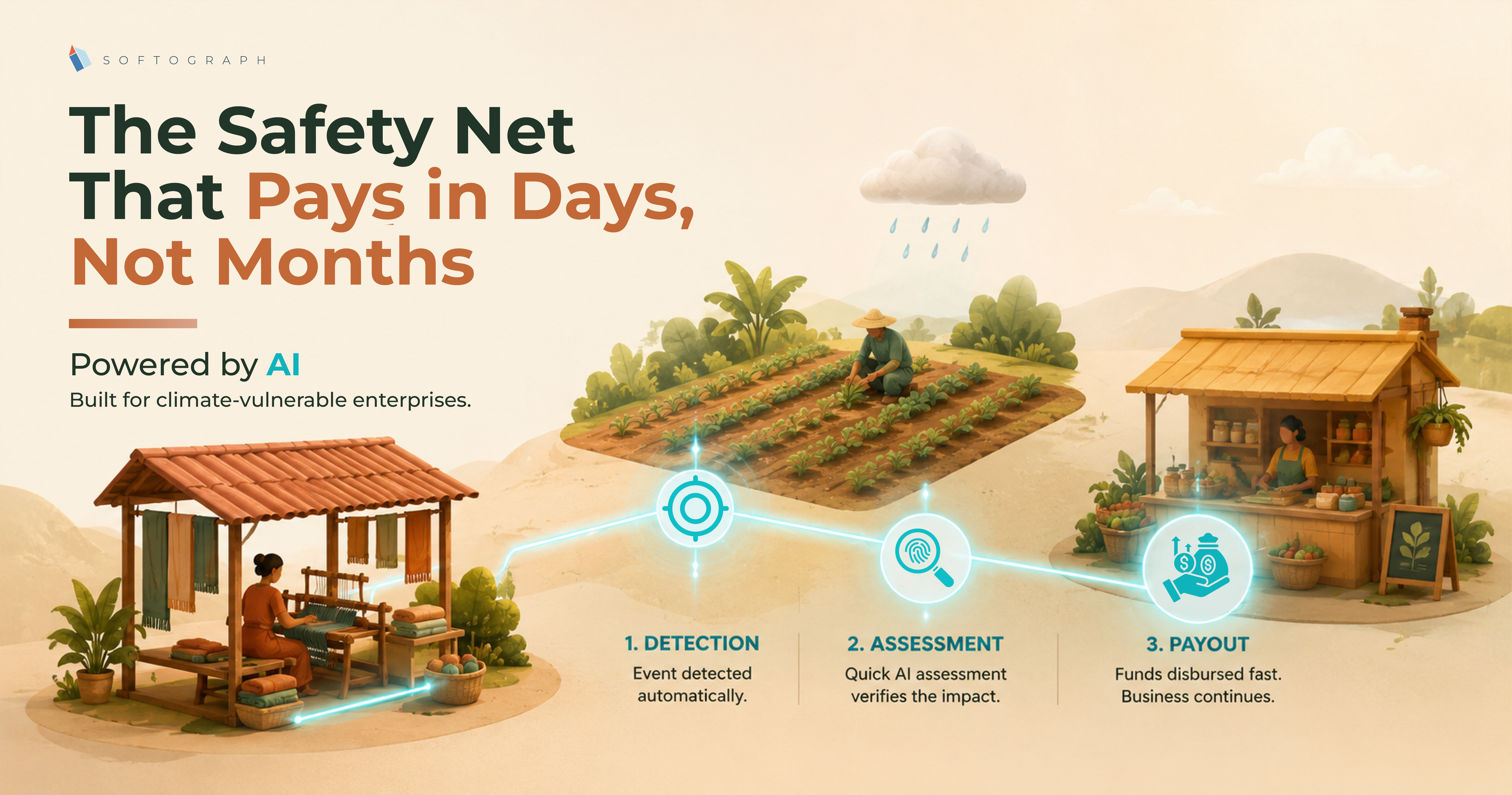
AI in Microinsurance: Accelerating Claims Settlement for Climate-Vulnerable Small Enterprises
For the cottage, micro, small, and medium enterprises operating on the frontlines of a warming planet, climate risk is not a line item in a strategy document. It is a Tuesday afternoon flash flood that erases a season’s inventory. It is a cyclone that arrives faster than the paperwork meant to protect against it. In these economies, resilience is not measured in quarters. It is measured in days, sometimes in hours, between a shock and a business’s ability to reopen its doors.
Microinsurance was designed to be the answer to exactly this problem. For decades, it hasn’t been. The gap was never a lack of intent. It was a lack of speed, and speed, in a climate emergency, is the entire product.
The Cost of a Slow Promise
Across climate-exposed regions, the riverine deltas and coastal belts of South Asia are among the most acute examples; insurance penetration among informal and small-scale enterprises still sits stubbornly below 0.5%. That number isn’t a market failure of demand. It’s a market failure of design.
Traditional indemnity insurance depends on physical inspection: a loss adjuster travels to the site, assesses damage against a paper baseline, and files a report that moves through a claims process built for a world with more time to spare. For an enterprise with thin cash reserves, this process is not merely slow; it is structurally punishing. Every week a payout is delayed is a week of compounding pressure: microloan installments still due, suppliers still expecting payment, a business owner facing an impossible calculus between preserving debt standing and preserving the business itself.
The result is a familiar and avoidable spiral. Liquidity dries up. Loan defaults spike. Businesses that survived the flood don’t survive the paperwork meant to help them recover.
Rebuilding the Claims Lifecycle Around Speed
What AI offers here is not a faster version of the old process. It’s a fundamentally different architecture for verifying loss and authorizing payment, one built to match the pace of the risk it’s meant to cover.
Visual verification, without the wait for a human inspector. Business owners or field agents capture geo-tagged, timestamped photos of damaged property on a smartphone before and after the event. Computer vision models compare these images against baseline data, estimating loss severity in near real time. The inspection still happens. It simply no longer requires a person to travel there to do it.
Climate data as an independent witness. Machine learning systems ingest parametric weather signals, satellite rainfall data, flood-level thresholds, wind speed readings, and cross-reference them against the location and timing of a reported loss. This does more than speed up verification; it removes ambiguity from the trigger itself. A claim is no longer a matter of one party’s word against another’s. It is a matter of what the weather data and the visual evidence independently confirm.
Fraud detection that works at the speed of submission, not the speed of audit. Automated integrity checks flag duplicate images, manipulated metadata, or location mismatches the moment a claim is filed, not weeks later in a retrospective review. This is what allows legitimate claims to move quickly: the system isn’t slower because it’s careful. It’s careful and fast, because those two things are no longer in tension.
From Asset Replacement to Business Continuity
The deeper shift AI enables isn’t just procedural. It’s conceptual. Rather than treating microinsurance as a slow-motion attempt to itemize and replace every damaged asset, a more resilient model protects the thing that actually determines survival: continuity of cash flow.
This is the logic behind Business Continuity Insurance: automated coverage structured around keeping loan installments current during a shock period, rather than adjudicating the value of every damaged good. It’s a narrower promise, delivered fast, instead of a broader promise, delivered too late to matter.
| Operational Dimension | Traditional Microinsurance | AI-Enabled Business Continuity |
| Claim Assessment | Manual site visits by loss adjusters | Visual recognition + climate data triangulation |
| Settlement Timeline | 30–90 days | 3–7 days |
| Primary Protection | Delayed asset indemnity | Immediate EMI relief, credit standing preserved |
| Cost Structure | High adjuster and administrative overhead | Automated validation at low marginal cost |
The difference between these two columns is not incremental. It is the difference between an enterprise that reopens within the week and one that spends the following quarter negotiating with creditors.
Resilience Is a Systems Problem, Not a Product Problem
It would be a mistake to read this shift as simply “insurance, but digitized.” What’s actually happening is a redefinition of what microinsurance is for. In climate-vulnerable markets, the product’s value was never solely in the eventual payout. It was in whether that payout arrived while it could still change the outcome.
As the frequency and severity of climate shocks increase, a trend every credible climate model now treats as baseline, not an edge case, static, slow-moving financial protection stops being a safety net and starts being a formality. The convergence of parametric climate data, mobile-first data capture, and AI-driven validation isn’t a convenience upgrade. It is the minimum viable architecture for insurance to remain relevant to the risks it claims to cover.
For microfinance institutions, insurers, and the policymakers who shape financial inclusion strategy across climate-exposed economies, the question is no longer whether AI belongs in this infrastructure. It’s how quickly that infrastructure can be built out to the enterprises who have been waiting on it the longest, not to help them survive the next shock, but to ensure the next shock is no longer the thing that decides whether they survive at all.