
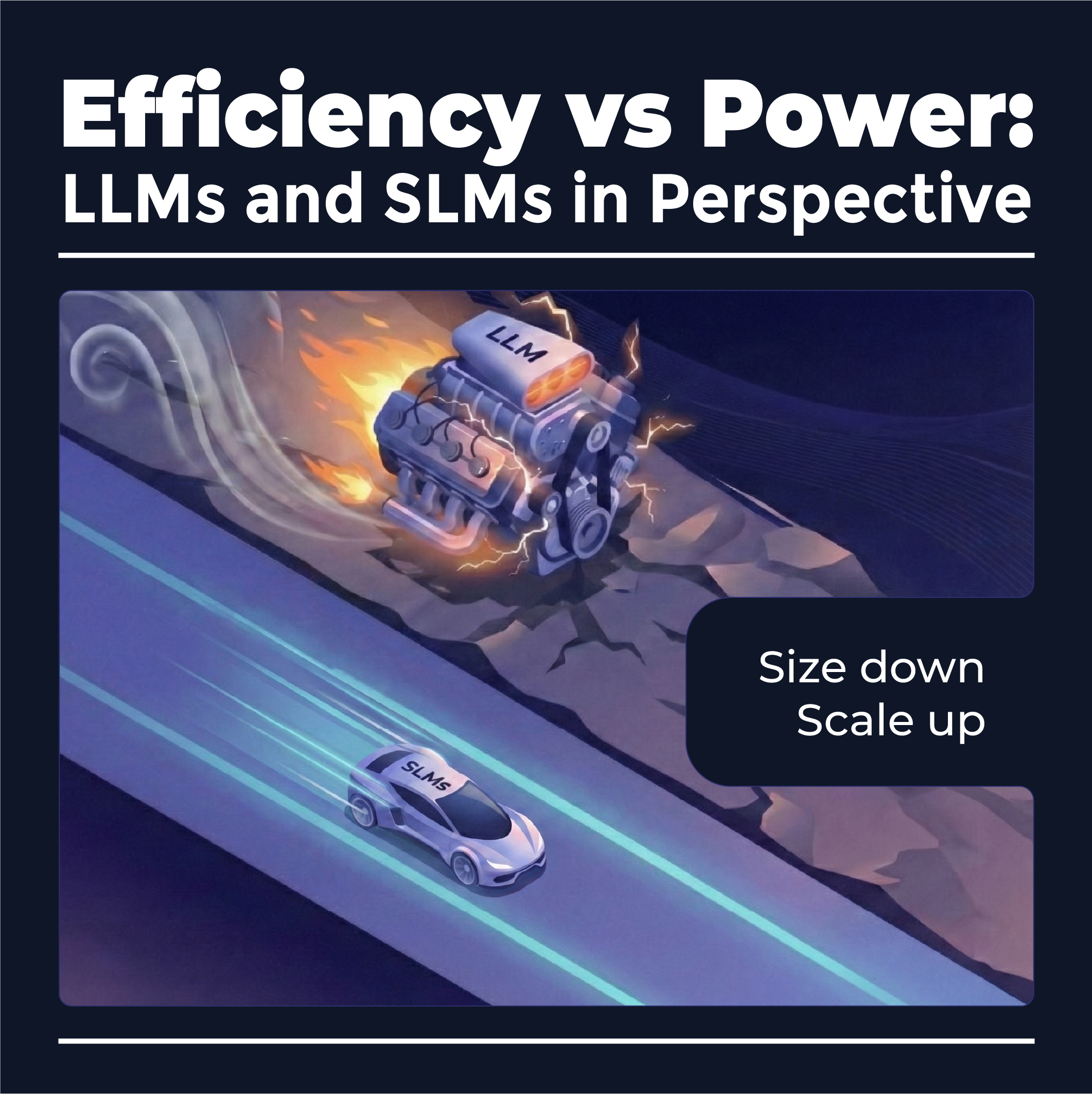
Efficiency vs. Power: LLMs and SLMs in Perspective
Two paradigms of today’s AI ecosystem, Large Language Models and Small Language Models, are shaping the trajectory of machine language. In the rapidly evolving AI landscape, the debate over LLM vs SLM has shifted from pure capability to strategic efficiency. While Large Language Models continue to set the gold standard for complex reasoning and creative depth, Small Language Models are proving that “bigger” is not always “better” for enterprise-scale deployment.
By analyzing the trade-offs between LLM vs SLM in terms of inference speed, operational costs, and data privacy, businesses can move beyond the hype to build a product strategy that is both powerful and sustainable. While LLMs prioritize sheer computational power and ingenuity, SLMs focus on usability, adaptability, and efficiency. Both are trained on similar principles of probabilistic predictions and neural architecture. However, they possess contrasting philosophies. Choosing the right LLM vs SLM strategy allows you to build a sustainable AI product that protects data privacy without sacrificing performance.
The Role of Scale in Shaping Capabilities
LLMs such as Anthropic’s Claude, Google’s Gemini, and Microsoft’s Copilot require enormous computational resources and large amounts of data to generate concrete, precise outputs. However, these models require specialized GPUs, continuous energy consumption, and substantial memory allocations. To enhance the efficiency of LLMs in specific scenarios, algorithms can be fine-tuned after initial training, also known as “pretraining,” as part of supplementary training. (1) In machine learning, LLMs use neural networks to solve problems. Although human involvement is often necessary for fine-tuning, deep learning models can effectively learn to identify discrepancies on their own. (2)
In contrast to billions or trillions of parameters, SLMs are intentionally downsized to operate on enterprise servers and in cloud environments with constrained resources while maintaining privacy. These models reflect the philosophy of efficiency at scale, ensuring seamless operations of everyday applications. With reduced training time, new applications can be developed, deployed, and tested faster. (3)
Scale as a Gateway to Versatility
The strength of LLMs lies in their comprehensiveness. Large Language Models (LLMs) are pre-trained on vast amounts of data. Their adaptability allows them to be configured for various tasks, such as translation, summarization, and literature generation. This flexibility will enable them to be optimized for specific tasks, making them more efficient and scalable. (4) From retail to healthcare, LLMs are utilized for a multitude of activities throughout multiple sectors. Companies can leverage this adaptability in several ways, such as through automated legal assessments, enhanced assistance for scientific research, and the creation of more extensive, authentic customer interactions. (5)
Large language models (LLMs) excel in situations characterized by complexity, ambiguity, and a need for nuanced argumentation that smaller models can only partially address. Yet this power comes with costs: financial, environmental, and privacy issues. Besides substantial carbon emissions and the expenditure of millions of dollars, LLMs have the cryptic ability to generate hyper-realistic texts and images, often contributing to the spread of misinformation and manipulation. (6)
Smaller Models, Greater Reach
Unlike traditional AI, Small Language Models (SLMs) are designed to be approachable, context-specific, and efficient. SLMs achieve faster estimation times, lower energy consumption, and greater deployment flexibility by customizing their parameter counts and concentrating on specific domains.(7) For example, the generalist capabilities of a large language model (LLMs) are not relevant for an SLM intended for medical diagnostics in remote healthcare facilities. Instead, the SLMs should be quick, accurate, and capable of operating on low-powered hardware.
Additionally, SLMs offer immediate adaptability in mobile applications, reducing the lag typically associated with cloud-based LLM requests. For intricate data engineering activities, for instance, SLMs are fine-tuned by vendors or enterprises using precise, domain-specific data. By adding domain-specific details to a user’s request, the response becomes more specific, and the user’s prompts are enhanced.
Choosing Between Versatility and Efficiency
The comparison between LLMs (Large Language Models) and SLMs (Small Language Models) involves trade-offs rather than a simple determination of which technology is superior. LLMs offer scalability and can be used to address complex problems involving multiple stakeholders. On the other hand, SLMs prioritize efficiency in action, providing quick, easy, and sustainable solutions. The tension between these two approaches reflects classic engineering trade-offs:
should we build a versatile machine capable of performing a variety of tasks that require significant infrastructure, or should we create a more specialized device that can integrate seamlessly into existing workflows?
Versatile AI systems, such as large language models, excel in complex tasks. They handle ambiguity, generate rich content, and adapt across domains. This makes them ideal for research, strategy, and high-level decision support. Efficient AI systems, including small language models, focus on speed and precision. They operate at lower costs, with faster responses, and with minimal infrastructure. This makes them well-suited for real-time applications, edge devices, and privacy-sensitive environments.
From an SEO perspective, clarity matters. Organizations searching for LLMs vs. SLMs are often seeking practical guidance, not absolutes. The real value lies in aligning AI capability with business needs. In modern AI strategy, efficiency and versatility should work together. Choosing the right balance enables scalable, responsive, and sustainable AI systems that perform where it matters most.
Finally, in a comprehensive AI ecosystem, efficiency and power are complementary rather than competing goals. Large Language Models bring depth, breadth, and advanced reasoning, while Small Language Models deliver speed, cost-efficiency, and reliability at the edge. When deployed together, they enable organizations to balance performance with practicality, using power where complexity demands it and efficiency where scale and responsiveness matter most. This synergy allows AI systems to be both ambitious and sustainable, increasing their overall effectiveness and long-term impact far beyond what either approach could achieve alone.