
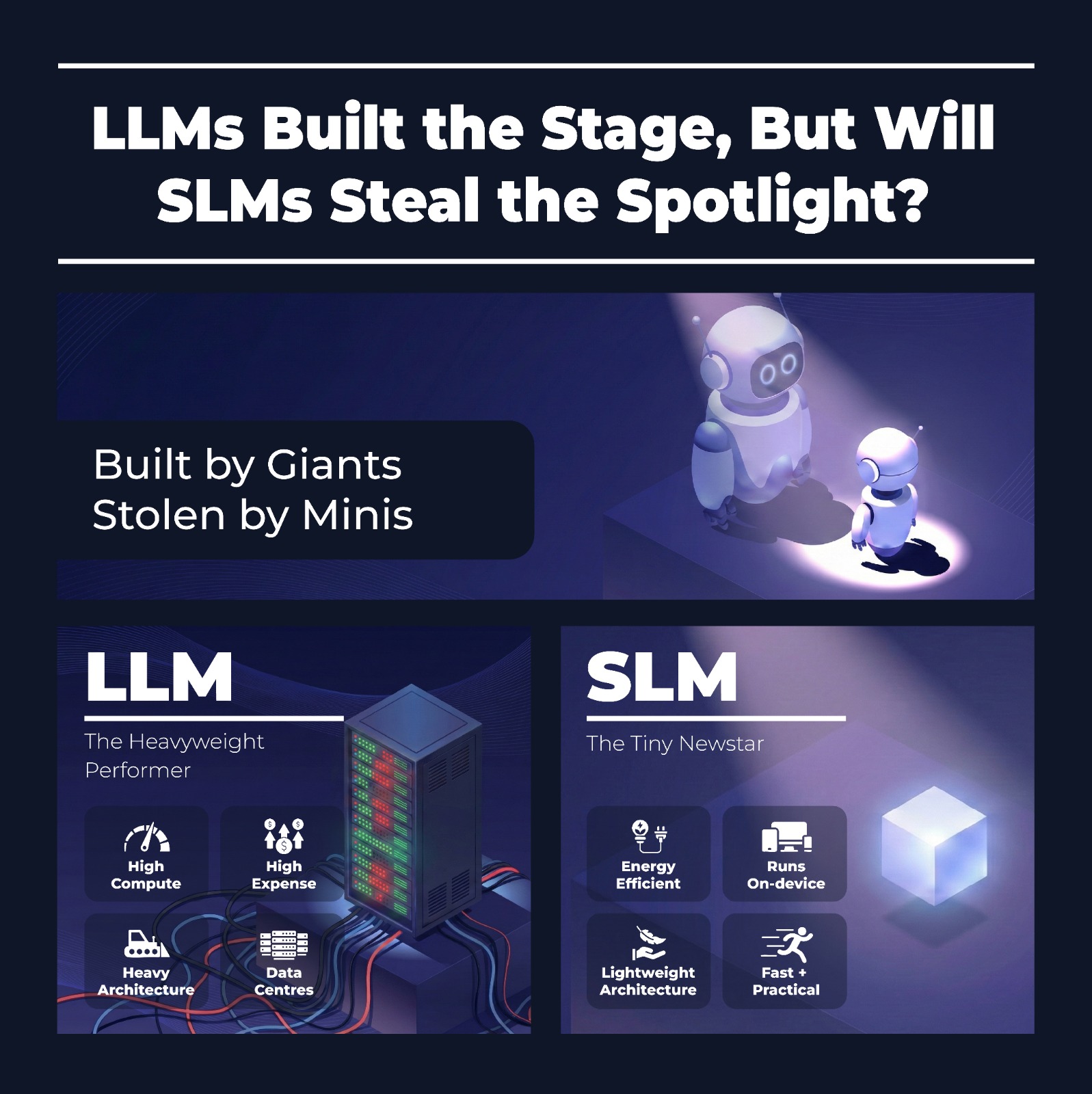
LLMs Built the Stage, But Will SLMs Steal the Spotlight?
Every new year, a paradigm arises that reshapes how businesses and individuals think about machine languages. The past half-decade has been dominated by ChatGPT and Claude-like Large Language Models (LLMs), which have demonstrated near-human creativity, reasoning, and fluency across various aspects. Artificial intelligence is evolving at a breakneck pace, relying on these massive data architectures. Yet a new player, Small Language Models (SLMs), is quietly entering the arena, with their lightweight, efficient, and increasingly compelling models.
This state of affairs poses an intriguing question: do we always need “large” to achieve impact? Or are we reaching an inflection point where “small” may be smarter, at least in certain contexts?
The Rise of Large Language Models
The theory that “the bigger the model, the more patterns it can learn” was first validated by OpenAI, who demonstrated that model performance improves as the parameters and training data increase. (1) In many ways, LLMs set the stage for AI’s mainstream adoption. Firstly, they can handle tasks from coding to composing poems, even if they were never explicitly trained for them. Moreover, LLMs do not require specific fine-tuning.
A large corpus of written text is used to pre-train LLMs via self-supervised learning. In pre-training, autoregressive algorithms are presented with text data from the starting point and asked to anticipate the word that will be used subsequently until the study is finalized. (2) Their universal adaptability from legal analysis to drug discovery is substantial. But the sheer size of LLMs demands powerful hardware and cloud infrastructure, posing a challenge to sustainability and efficiency.
The Case for Going Smaller
Small Language Models (SLMs) are compact AI systems engineered for efficiency. The concept of these models is not to compete with the largest models but to offer intelligence at lower cost, faster speed, and greater accessibility. (3) Thanks to advances in distillation techniques and quantization, SLMs can deliver competitive performances for specific use without requiring massive computational overhead. For instance, Mistral 7B is a smaller open-source model that achieves stronger results on benchmarks than LLaMA 2 13B. (4)
On the other hand, Phi-4 is the newest SLM optimized for complex reasoning in mathematical analysis and performs better than other models such as Gemini Pro 1.5 and Qwen 2.5. (5) Hence, the mighty SLMs expand their expertise across legal firms and financial services without the expanse of operating behemoth LLMs. When it comes to training or fine-tuning, SLMs are far more conducive to specific activities than generic LLMs. Their smaller scale makes them inclined to personalization and experimentation.
Complementary, not Competitive
It is tempting to frame the conversation as a competition: will SLMs replace LLMs? But in reality, the spotlight may be shared. While LLMs excel at being generalists, with broad, open-ended reasoning and tasks that demand immense contextual knowledge, SLMs are the specialists when speed, efficiency, and contextual adaptions become urgent. Despite their apparent supremacy, SLMs face hurdles when their smaller parameter limit affects reasoning and creativity. With reduced capacity, they risk oversimplification in complex domains. Interoperability between the two will cause organizations to deploy a layered approach, relying on broad general knowledge while also cultivating specialized skills tailored to their environments.
In essence, the future of AI will not be dictated by one model size winning over another, but about matching the right model to the proper context, ensuring intelligence is as adaptable and distributed as the world seeks to serve. Fluidly scalable systems, which can grow when complexity demands it and shrink when efficiency counts, and which collaborate across layers of intelligence instead of striving for dominance, will be the systems of the future. Progress, as AI is integrated into ordinary infrastructure, will depend less on creating the largest model and more on coordinating the most intelligent ecosystem. What we need is a new age of modular, responsive intelligence that is deeply woven into the human experience rather than a singular architectural marvel.