
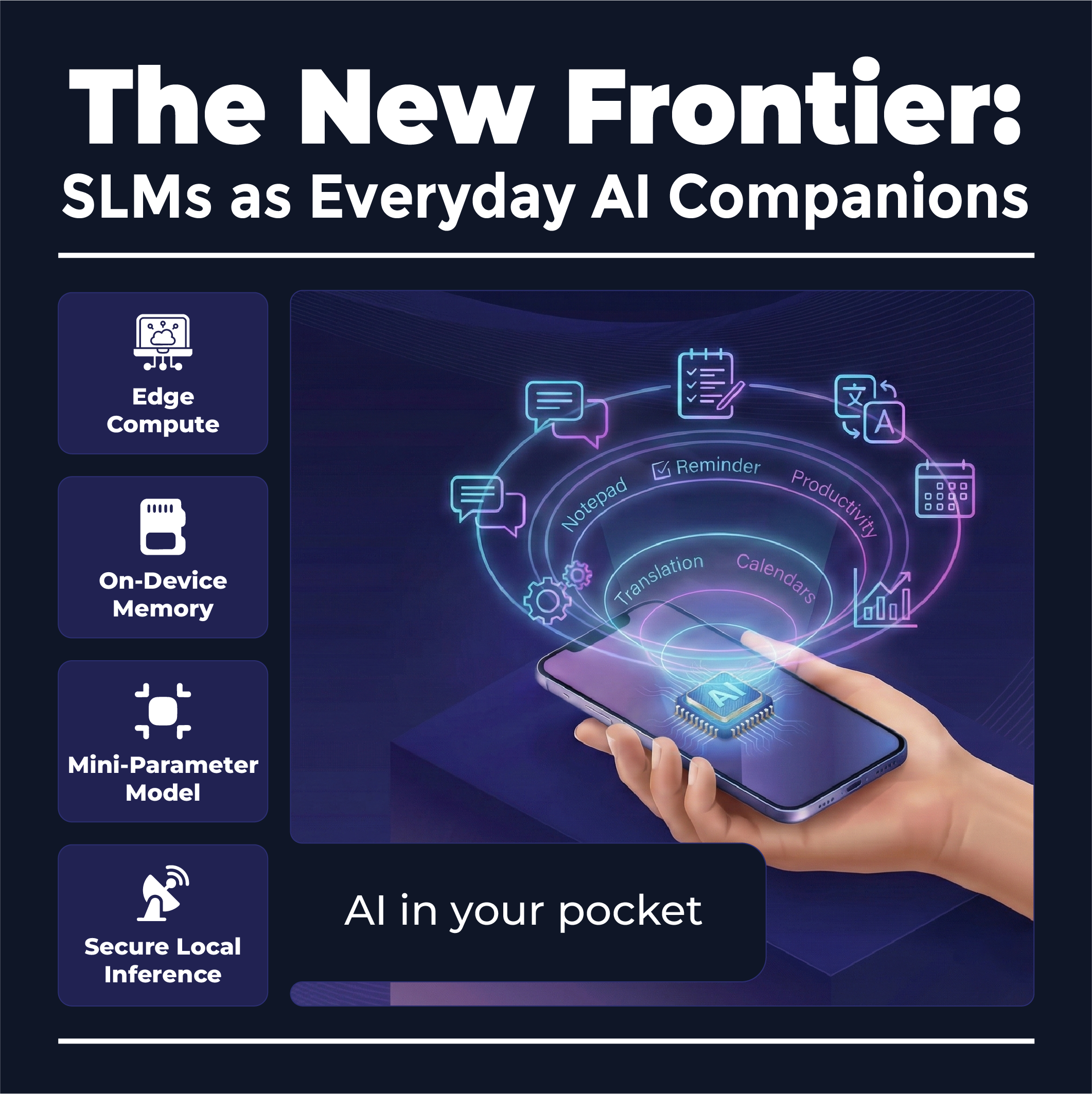
The New Frontier: SLMs as Everyday AI Companions
Artificial intelligence has entered the mainstream of the tech world with Large Language Models (LLMs), creating a bridge between humans and machines and shaping their interactions with technology. But unlike their larger relatives and architectures built on billions of parameters, Small Language Models (SLMs) have emerged with their lean design and accessibility, becoming faithful companions of everyday life. This shift makes a new frontier: one where intelligence is not only powerful but also personal, portable, and pervasive.
What defines a Small Language Model?
Small Language Models like DeepSeek and Gemma are not simply an underpowered version of an LLM. They are intentionally designed for compactness and efficiency, often with improved capabilities despite their reduced size. Their emphasis is on lightweight design, context-specific adaptation, accompanied by lower cost and energy use. 1 Rather than being judged solely based on scales, they serve practical contexts where LLMs are unnecessary and inefficient. Because they are trained on specific datasets and a smaller codebase, SLMs are dependable across diverse business requirements, provided they are factually correct. They are less prone to exhibiting bias, thus ensuring greater security.
One of the key benefits of small language models is their lightweight design. This means they require less computing power and energy, making them more cost-effective to use. They are also tailored for specific tasks or contexts, which allows them to perform effectively in situations where larger, more complex language models would be overkill. 2 3
Instead of evaluating them just by their size, we should appreciate these models for their practical applications. They excel in scenarios where using a full-scale language model is unnecessary or inefficient, providing valuable solutions for a variety of needs. SLMs are deployable on IoT devices and laptops, allowing targeted fine-tuning for specialized domains. They are built on a simpler neural network framework, enabling them to operate with less computational power on domain-specific platforms such as virtual assistants and chatbots.
When Scale Meets Everyday Use
Trained on vast corpora of parameters, LLMs have demonstrated the extraordinary potential of scale. As “broad generalists,” they are capable of handling diverse tasks from reasoning to translations. But their demands for immense computational resources and their reliance on cloud infrastructure draw the line between LLMs and SLMs. SLMs, on the contrary, offer a different proposition. They redefine proximity in intelligence, transforming them into accessible companions. Primarily, their functionality in low-connectivity environments makes them reliable partners for fieldwork, travel, and classrooms. Moreover, instead of switching to a different platform, SLMs have assistance integrated within apps and regular tools. Besides, SLMs offer organizations the flexibility to customize for unique use cases, whereas LLMs do not fully adapt to new scenarios and concepts. SLMs are like small notebooks, always within reach, invaluable in their immediacy and modest in their scale. 4
Imagine a health worker visiting patients in a remote village where the internet is slow or unreliable. On their tablet is a small AI assistant that works offline. As they talk to patients, they can note symptoms, organize information, and prepare clear next steps, all without needing a network connection. There is no waiting for apps to load, no jumping between tools, and no data being sent elsewhere. In situations like this, a large, internet-dependent AI is not practical. The smaller one is. Like a notebook kept in a pocket, its value comes not from knowing everything but from being ready whenever needed.
Use Cases that Redefine Proximity
Whenever we use standard technologies, such as a home automation system, SLMs silently operate in the background. They make these gadgets more innovative and efficient by enabling them to understand users without internet access. By evaluating patient data, providing diagnostic prompts, and writing medical notes, personalized models can aid physicians without revealing confidential information to third-party systems.
Banking is another area where small models are quietly reshaping everyday experiences. From speeding up internal processes to improving customer interactions, SLMs help banks operate more efficiently while keeping costs under control. They can support fraud checks, customer assistance, and internal workflows without relying on constant cloud access, an advantage in both performance and security. The relevance of SLMs in effective banking systems continues to grow. They are indispensable to banks, given the multitude of ways they promote operational efficiency, enhance the client experience, and minimize expenses. To sum up, SLMs are better suited to the real-world requirements of everyday living than their larger equivalents. 5
In the conclusion, the shift from giant to companions is not about diminishing capabilities but about changing contexts. Dependable and human-centered SLMs are becoming trusted partners in our daily lives. The future will not be shaped on a massive scale, but by an intelligence that accompanies us on our journeys in a subtle yet dependable way. They lean on cloud-based systems, SLMs excel in offline scenarios, offering seamless performance even in remote or low-resource settings. Their compact architecture ensures faster response times and reduced latency, making them ideal for real-time applications where efficiency and accessibility are paramount.