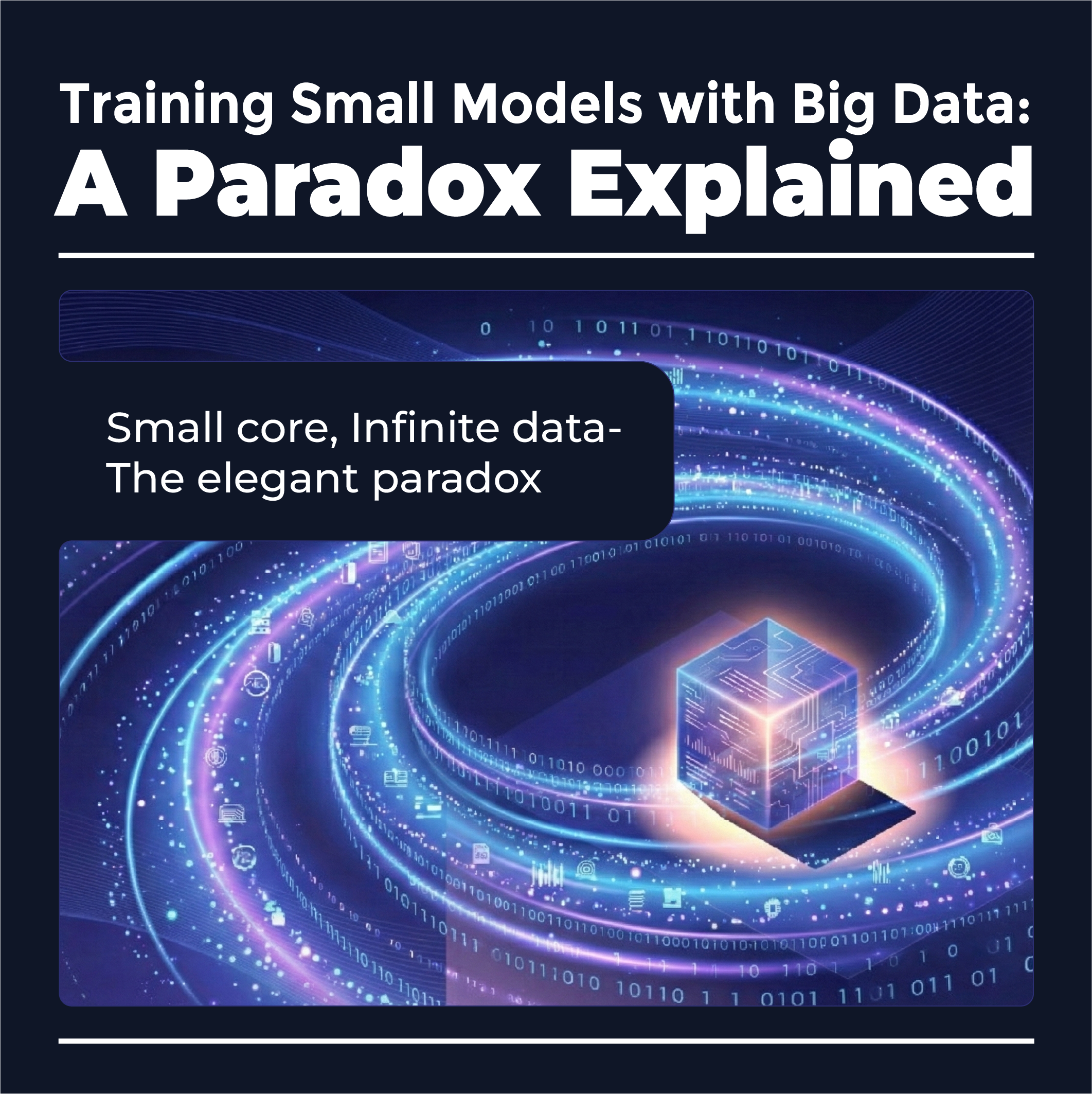
Training Small Models with Big Data: A Paradox Explained
Training small language models with big data may sound contradictory at first. Modern AI often follows the idea that bigger is better, with billions of parameters and massive datasets. Yet small language models (SLMs) are built for limited devices and tighter budgets. Despite their size, they rely on large datasets during training to achieve strong performance. At the same time, these are designed to fit limited devices and tighter budgets. This creates an apparent contradiction. While these models are compact, they often rely on very large datasets during training.
The irony is important. SLMs can adapt surprisingly well when they learn from carefully curated outputs of larger models. This “big-to-small” pipeline may feel counterintuitive, but it is becoming a key strategy for the next phase of AI development.
How Large Models Become Teachers
A large “teacher” model can present labeled and unlabeled (pseudo-labels) proper signals in the data. Meanwhile, small models act as “students” and mimic the outputs through the process of “Knowledge Distillation.” (1) When LLMs step back due to their slow speed, SLMs take centre stage with their fast and innovative generation. Moreover, SLMs may be provided with a chain of thought steps to help them learn more efficiently.
It sounds like a contradiction: how can small AI models learn so much from vast oceans of data?
The extracted rationale from an LLM is deployed to distribute information, helping SLMs generalize more effectively. (2) What appears paradoxical is, in fact, a carefully designed synergy, where compactness provides usability and scale offers structure. The power of bid data lies in patterns, pathways, and probabilities that a smaller model can transform into lean efficiency. This approach shows why training small language models with big data is essential for building efficient and scalable AI systems.
Why This Paradox Matters
Efficiency is no longer optional. It is a requirement. AI models that depend on massive server farms may look impressive in research labs. But they struggle in everyday situations. They cannot run smoothly on mobile phones. LLMs fail in areas with weak or unstable internet. They also cost more to maintain and scale.
Think about a smartphone user. They want quick responses, not delays caused by cloud processing. A voice assistant that only works with a strong internet connection is unreliable. A smaller model that runs directly on the device works better. It responds faster and keeps data private. In real life, that difference matters. What truly matters is balance. Intelligence must be powerful, but also practical. Compact models trained with large-scale knowledge offer that balance. They learn from big systems, but operate on small devices. This is how the paradox resolves itself. Large principles shape small systems.
Advanced reasoning no longer belongs only to supercomputers. It becomes part of daily life. Small models make this possible by carrying distilled knowledge where people actually need it. They prove that AI does not need to be huge to be helpful. It only needs to be available.
From Theory to Training
A simple method to improve the performance of most machine learning algorithms is to train multiple models on the same dataset and then compare their predictions.(3) Knowledge distillation is a formalized technique through which small models or SLMs learns patterns and generate accurate outputs along with relative probabilities of alternatives. It can democratize intelligence by making advanced AI capabilities accessible to a broader audience, regardless of their computational resources. These models can operate efficiently on everyday devices, bringing powerful AI tools into the hands of individuals and small organizations.
This widespread accessibility empowers people to leverage AI for diverse applications, from personalized education to improved healthcare solutions. Executing large models on smaller devices is challenging due to resource constraints, which is particularly relevant for applications that use Natural Language Processing (NLP) with TinyML and LLMs.(4) For instance, DistilBERT, a widely used model, demonstrates how an individual’s operational footprint is retained while retaining 95% of its teacher’s linguistic knowledge. (5)
The apparent contradiction of “training small models with big data” becomes clear when we explore how large datasets and models function as instructors. We can see how supervision can provide valuable information beyond just final labels. Additionally, techniques like distillation enable small language models (SLMs) to benefit from many of the advantages of large language models (LLMs) without requiring the same volume of data. By understanding these trade-offs and applying the proper methods, engineers and researchers can develop effective models that perform well under real-world constraints.