
Why BI Investments Stall: A Root Cause Analysis for Bangladeshi Enterprises
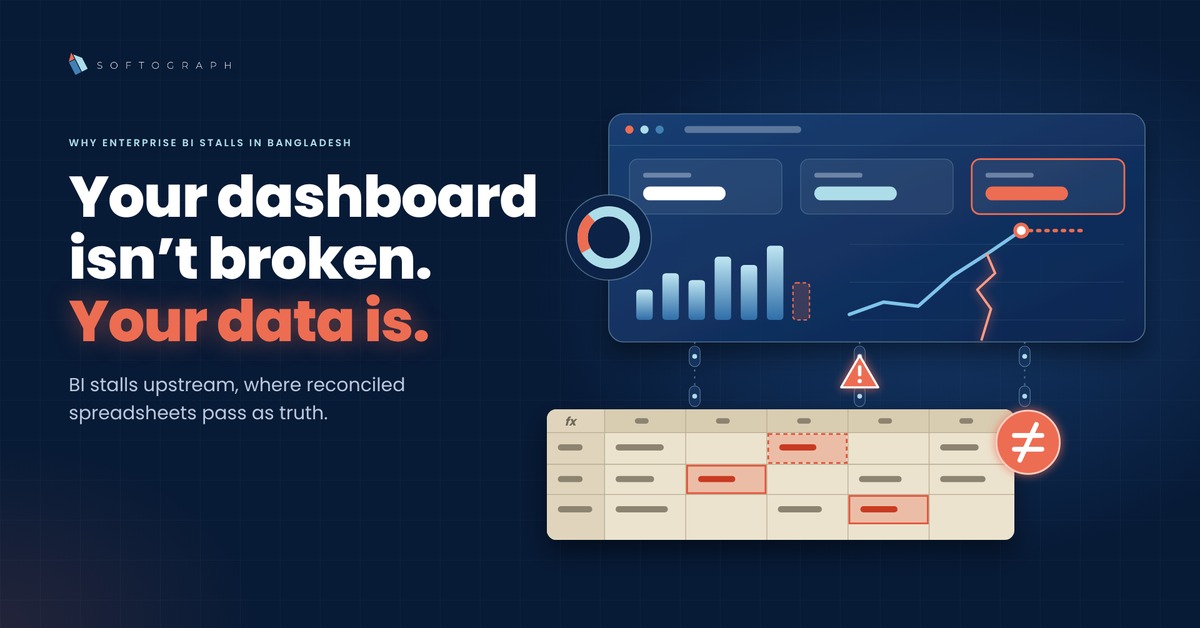
Enterprise reporting projects rarely fail on the glass. They fail because the pipeline treats human reconciliation as raw truth. Every major enterprise across Bangladesh runs the same quiet experiment.
A conglomerate board authorizes a seven-figure investment into modern data infrastructure. Global licenses are procured. A systems integrator models the schema, wires the connectors and delivers a set of executive scorecards. For three weeks, leadership studies the clean charts.
By month two, the finance director notices that depot-level inventory does not match the month-end ledger balance. By month three, branch managers have gone back to tracking credit returns in local desktop workarounds. The executive team quietly returns to making capital decisions from thirty-page spreadsheet decks shared twenty minutes before the board convenes.
The software remains active. The investment stops yielding decisions.
When data engineering teams conduct post-mortems on stalled analytics initiatives across Dhaka and Chattogram, they blame interface design. Operational reality breaks down three layers before the visualization layer ever renders a pixel.
The Upstream Flaw: Ingesting Reconciled Truths
Most corporate analytics pipelines in the region make an unexamined structural error: they ingest adjusted summaries instead of immutable operational events.
Consider a multi-tier distributor serving retail points outside urban centers. On paper, central procurement rules govern inventory movements. On the ground, depot managers routinely absorb minor transit losses, credit extensions, and sudden retailer returns into unofficial local ledgers. They balance these ledgers manually every Thursday evening before feeding a sanitized summary upward.
When an ingestion pipeline pulls these intermediate files, it automates the transmission of manual corrections rather than actual commercial behavior. One of the biggest reasons BI investments in Bangladesh lose momentum is fragmented data trapped inside disconnected ERP, accounting, and spreadsheet systems.
The moment central finance audits the physical stock counts against the general ledger, the variance re-emerges. Executive trust evaporates. In corporate governance, credibility is binary: once an executive proves that a single data point in a dashboard requires a spreadsheet to explain it, the entire screen is dismissed as academic.
Sustainable enterprise architecture does not ingest aggregated spreadsheets. It captures primary, tamper-evident transactional logs at the point of activity: bank settlement webhooks, point-of-sale event streams, and raw warehouse gate passes. The reconciliation logic must exist entirely within audit-ready, automated code, not behind desk-in-cell formulas.
The Point-of-Capture Problem
Downstream pipelines cannot engineer integrity into data that arrived without constraints.
Across legacy operational systems in Bangladesh, input validation is frequently treated as an administrative nuisance. Order clerks bypass required customer tax identifiers by inputting repetitive placeholder numbers. Warehouse operators bundle disparate SKUs under single legacy product codes to expedite peak-hour truck loading. Field officers post blanket volume discounts at the end of the billing period rather than assigning them line by line to actual shipments. Without executive buy-in and team-level data literacy, even the most expensive BI investments in Bangladesh risk becoming unused reporting tools.
When a downstream analytics model attempts to calculate customer-level lifetime value or SKU-level gross margins, the transformations fail or produce distorted conclusions.
No machine learning model or analytical dashboard can deduce the origin of a generic bulk code. Fixing corporate reporting is fundamentally a disciplined software engineering problem at the entry boundary: enforce key integrity at the database level, reject payloads via API gatekeepers, and eliminate miscellaneous fields from transactional software.
When Schemas Follow Corporate Politics
A dashboard should expose operational friction. In practice, enterprise reporting pipelines are often negotiated into political truces.
When data platform initiatives are managed as isolated technology rollouts rather than foundational operational standards, metric definitions are gathered through decentralized stakeholder interviews. The supply chain division defines fulfillment as the moment a shipment departs the primary hub. The regional commercial team defines fulfillment strictly upon customer receipt, deliberately excluding returned goods to protect territory targets.
Faced with conflicting internal mandates, engineering teams introduce hardcoded conditional flags and custom SQL patches to satisfy competing executives. Over consecutive quarters, the reporting pipeline degenerates into an unmaintainable tangle of edge-case exceptions.
When two department heads require a committee meeting to agree on the definition of “net revenue,” the enterprise does not lack analytical software. It lacks a unified operational contract.
The Path to Usable Systems
Turning stalled analytics infrastructure into reliable operational clarity requires abandoning the assumption that reporting is an IT support task. It is foundational operational engineering:
- Establish rigid, standardized data definitions across all business units before writing transformation queries.
- Cut off secondary desktop reports and direct the pipeline strictly to immutable transaction databases and system event logs.
- Deploy automated data quality assertions that fail visibly at the pipeline boundary whenever incoming operational entries violate defined schema constraints or drift from the core ledger.
- Ultimately, successful BI investments in Bangladesh depend less on the software vendor you choose and more on aligning data quality, workflows, and decision-makers from day one.
When the ingestion pipeline’s engineering is rigorous, the dashboard needs no defense.