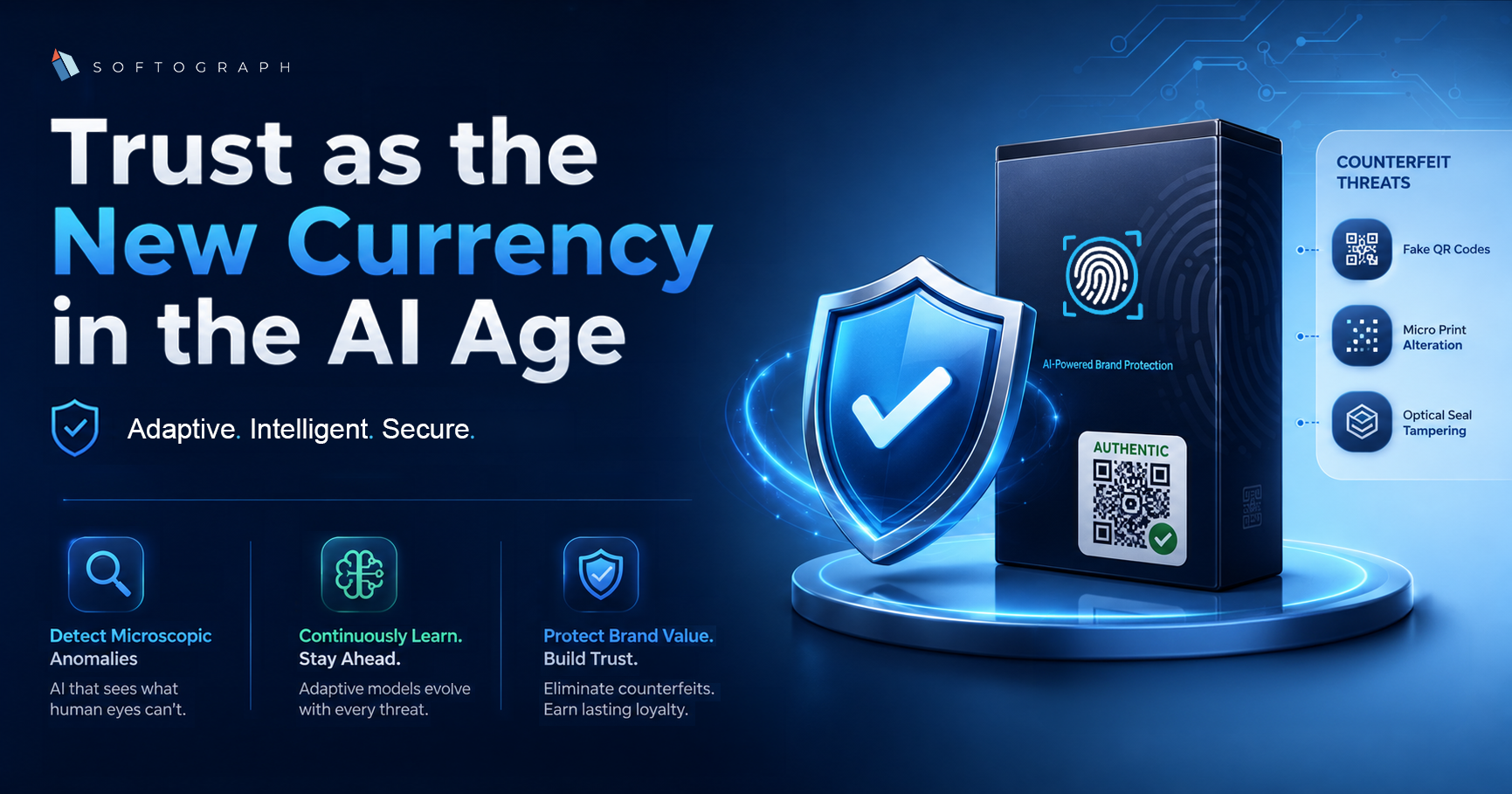
Trust as the New Currency in the AI Age
The moment synthetic tools learned to replicate physical reality, the rulebook for modern commerce was rewritten. For decades, global brands relied on a simple promise: if a product carried your logo, your packaging, and your security seal, customers could trust it.
That promise is officially broken.
With generative AI, physical packaging is now just as easy to forge as digital media. Counterfeiters aren’t using cheap printers anymore; they’re using algorithms. In a world where machines can clone reality down to the microscopic level, brand protection is no longer just a supply chain detail. It’s an existential battle for customer trust.
The Invisible Epidemic: When Perfect Fakes Pass Every Test
The most dangerous counterfeit isn’t the crude, easily spotted knockoff sold on a street corner. It is the hyper-realistic twin sitting right beside your legitimate product on a mainstream retail shelf, completely indistinguishable from the original.
Modern bad actors have traded primitive printing presses for high-resolution generative tools, cloning complex packaging signatures with terrifying accuracy. In this new era, legacy security features, including basic barcodes, static QR codes, holographic foil stickers, and standard optical seals, are practically obsolete. Fakes slide right past them because those old barriers were never built to withstand algorithmic replication.
When a counterfeit item looks, feels, and scans identically to the real thing, traditional brand equity loses its armor. A century of hard-earned consumer loyalty can evaporate overnight because of a single batch of illicit goods that triggers safety hazards, causes compliance failures, or ruins user experiences.
In a hyper-synthetic marketplace, your brand name alone cannot protect your bottom line. When anyone can mimic your physical presentation, verifiable, algorithmic trust becomes the only true currency of enterprise value.
The Blind Spot in the Machine: Why Legacy Scanners Fail
Traditional security systems are falling behind because they rely on static visual filters, outdated rules built for a much simpler era. They evaluate packaging by comparing physical items against a single, frozen baseline image. If the logo matches the template and the barcode reads correctly, the system gives it a green light.
Sophisticated counterfeiters understand these rigid mechanics inside and out, and they are actively weaponizing adversarial AI to exploit them. By injecting imperceptible digital tweaks, invisible line-work shifts, micro-text distortions, synthetic noise patterns, or subtle ink density changes, bad actors engineer intentional visual dissonance onto the counterfeit packaging.
To a human inspector, the packaging looks pristine. But to a traditional AI scanner, that engineered noise triggers an algorithmic loophole. The legacy software gets tricked into ignoring the anomalies, reading the manipulated fake signatures as a verified “PASS.”
This flaw creates a massive, silent vulnerability across global supply chains. When static scanners can be easily blinded by synthetic noise, brands aren’t just losing money on ineffective security software; they are actively allowing high-grade counterfeits to pass through fulfillment centers and land directly in the hands of unsuspecting consumers.
The Shift: Moving from Static Gates to Smart Defense
Relying on old inspection software gives brands a dangerous, false sense of security. Because traditional systems use fixed rules, they are completely reactive. They can only catch threats they’ve already been programmed to see, meaning fakes hit the market long before your software gets updated.
To close this gap, visual verification has to evolve. Brand security can’t be a passive checkpoint anymore. It needs to operate as an active intelligence network that analyzes how packaging data behaves under real-world conditions, shifting light, and synthetic disruptions.
When your security system understands the underlying physics and structural nuances of your packaging rather than just its surface appearance, fake products lose their camouflage.
The Solution: Safeguarding Value with Detectron
To stay ahead of algorithmic threats, brand protection cannot rely on a static barrier; it must operate as an adaptive, continuous learning loop. That is precisely why
Detectron was built. Developed by Softograph as an AI-powered counterfeit detection platform, Detectron replaces rigid rule-matching with advanced visual intelligence engineered to catch microscopic packaging anomalies long before products ever reach retail shelves.
- Micro-Texture Analysis: Instantly evaluates substrate fiber structures, paper density, and material compositions to catch unauthorized packaging materials.
- Sub-Pixel Verification: Scans print registration down to fractions of a millimeter, flagging imperceptible logo shifts, line-work deviations, and ink density alterations.
- Continuous Threat Simulation: Proactively simulates generative packaging attacks and trains its vision models against emerging adversarial noise in real time.
- Sub-Visual Pattern Recognition: Validates embedded security markers, micro-print alignments, and ink diffusion patterns that remain completely invisible to the naked human eye.
Catching fakes isn’t about setting up a passive checkpoint anymore. With Detectron, enterprises transform visual verification into an intelligent, adaptive shield, eliminating downstream liability, insulating global supply chains, and securing unshakeable consumer trust in the AI age.