
Conversational AI for Executives: From Dashboard to Dialogue
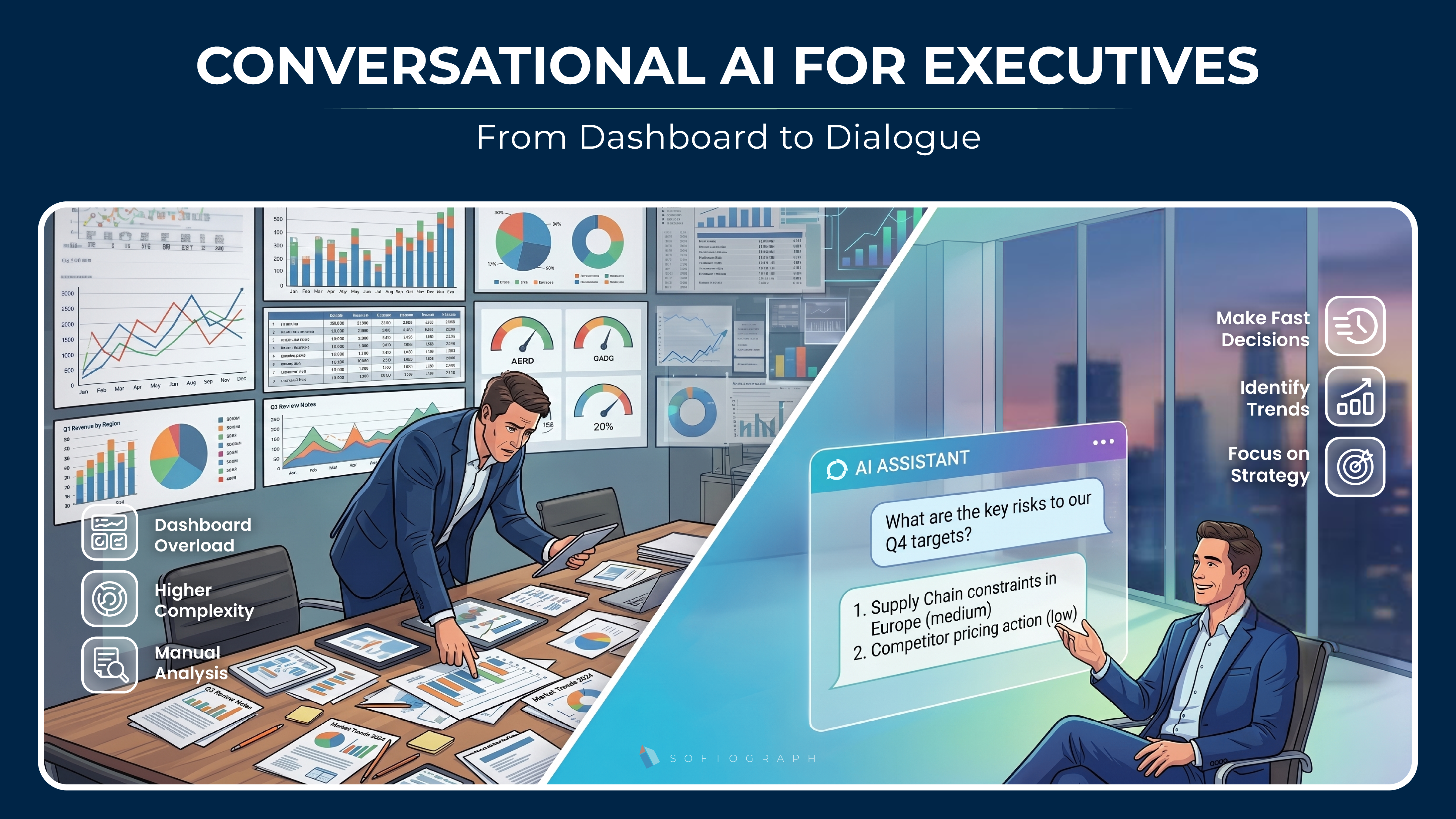
The modern executive is drowning in data but starving for insights. For years, the corporate world has relied on “static snapshots,” glossy, colorful dashboards that look impressive in a boardroom but offer little utility when an operational crisis hits unexpectedly on a Tuesday afternoon.
The rapid adoption of conversational AI by executives is shifting the corporate landscape away from static, time-consuming business intelligence setups and toward immediate, text-based data discovery. The problem isn’t a lack of information; it’s the friction involved in extracting it. The evolution from dashboard to dialogue marks the end of this waiting game. Enterprises are moving toward a reality where your database doesn’t just store information; it listens, understands, and talks back.
The Frictionless Frontier: Beyond the Data Silo
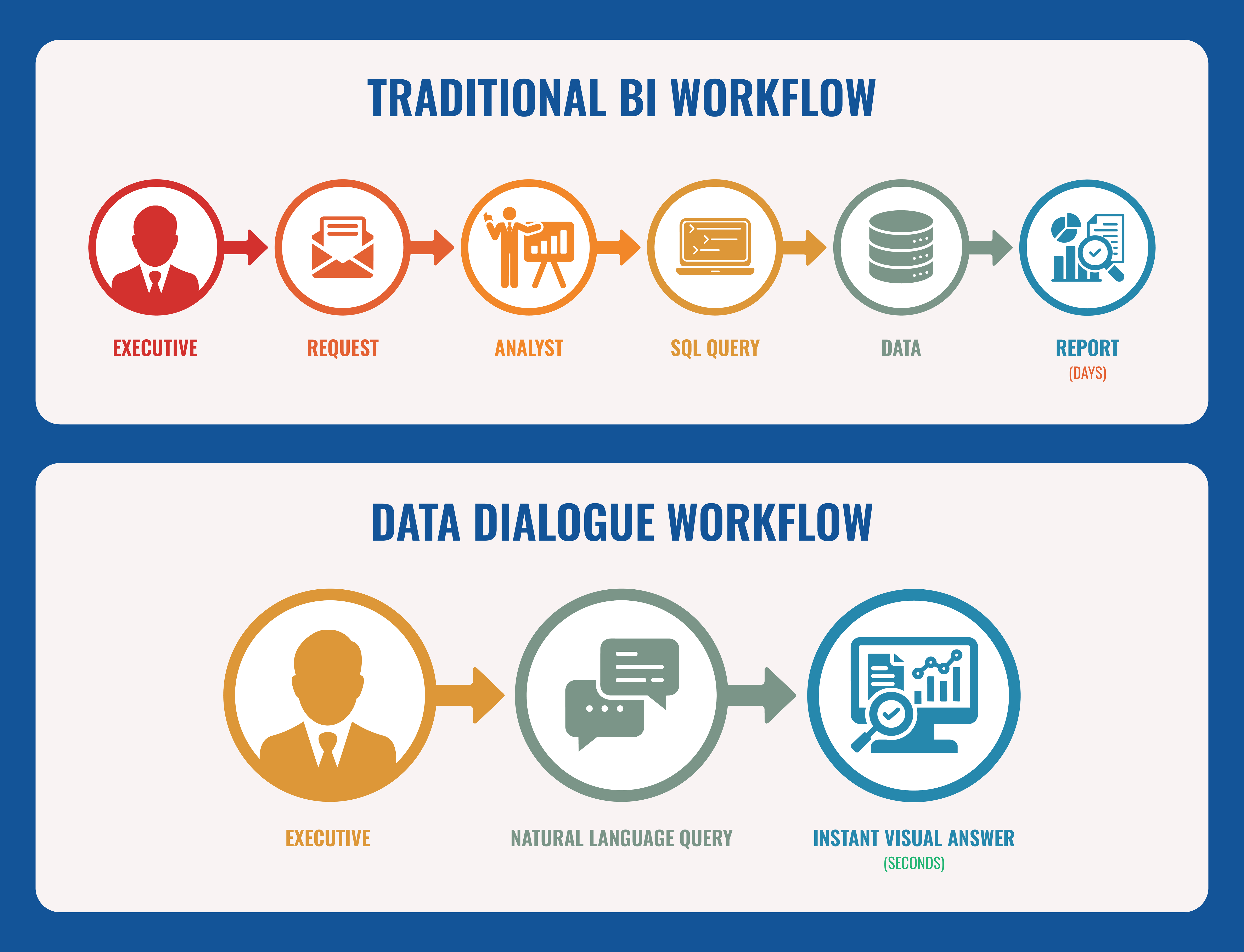
The traditional relationship between an executive and enterprise data is almost always mediated by technical gatekeepers. To get a simple answer, leadership typically relies on a data analyst to translate a business question into a complex SQL query. This creates a structural bottleneck where strategic curiosity is penalized by wait times. When asking a question takes longer than the problem’s shelf life, leadership teams simply stop asking.
Breaking this cycle requires a fundamental shift toward data democratization. By integrating standardized databases with a sophisticated natural language layer, the core engine behind Softograph’s Data Dialogue, the technical barriers evaporate.
This architecture allows business professionals to bypass the technical phase entirely. Instead of navigating a maze of legacy filters, users interact with enterprise data through a clean, intuitive interface. The result is a more agile organization where insights flow freely across departments:
Logistics managers can instantly check fleet efficiency.
Commercial heads can query inventory levels across regional hubs without waiting for weekly reports.
Cross-functional teams can make immediate decisions without a dependency on IT.
Context is King: Teaching AI the Language of the Boardroom
Raw data is merely noise without context. A machine sees a column of isolated integers; an executive sees Quarterly Revenue Targets, Customer Retention Rates, or FMCG Supply Chain Velocities. Most generic analytical tools fail because they lack the specific operational vocabulary of the business they serve.
To bridge this gap, conversational intelligence must be anchored to custom business logic. This is where Data Dialogue diverges from standard generative AI wrappers. By embedding proprietary business definitions directly into the NLP engine, the system transitions from a basic calculator to an automated strategic consultant.
Strategic Impact: Whether managing complex distribution networks in Dhaka or analyzing exploratory market trends in the UAE, the system recognizes your specific KPIs. It understands that “growth” carries a different meaning for a newly launched digital product than for an established regional brand.
This contextual awareness delivers a level of precision that static dashboards cannot replicate. When asked, “Why is performance lagging in the logistics sector?” the platform doesn’t just return a generic spreadsheet. It analyzes the specific parameters of your operational model to identify hidden correlations, such as micro-demands or procurement delays, ensuring every insight is relevant, actionable, and aligned with executive vision.
Visualizing the Answer: Instant Insight, Zero Effort
An answer is only as valuable as its delivery, and in high-stakes environments, speed is the ultimate currency. The final stage in the conversational evolution is the seamless shift from text-heavy reports to automated, AI-driven visualizations.
When an executive queries market penetration, they do not want to sift through a 50-row table; they require a clean, visual representation of the trend that can be synthesized in seconds.
By pairing natural language processing with robust data analytics engines, the system automatically selects the optimal visualization format for the requested data:
Comparisons automatically render as clean bar charts.
Time-series data instantly maps to clear line graphs.
Structural breakdowns generate immediate data matrices.
This automation eliminates the manual overhead of building slide decks or formatting reports, allowing leadership to reallocate energy from data manipulation to strategic execution.
Ultimately, this paradigm shift gives executives the clarity to lead with data-backed precision rather than assumptions. By adopting a conversational data infrastructure, modern leaders eliminate technical friction, reclaim critical operational hours, and make high-stakes decisions with the confidence that comes from immediate, democratized information.