
Gamification vs. Loyalty Points: What Actually Drives Consumer Behavior in Emerging Markets
Traditional loyalty points are fast losing their grip, buried underneath a mountain of abandoned mobile applications across the world’s most dynamic emerging economies.
For over a decade, consumer brands operating in emerging markets have relied on a predictable playbook: buy a basic reward tracking system, hand out arbitrary points for transactions, and expect customer retention to take care of itself. When analyzing long-term retention in expanding regions, the critical structural question centers on gamification vs. loyalty points and how each impacts genuine brand connection. But as a hyper-connected, mobile-first generation takes over the consumer class, this transactional approach is flatlining. Modern consumers are completely fatigued by complex point-redemption systems that demand months of spending just to receive a low-value voucher.
In high-velocity markets, delayed gratification does not scale. The battle for consumer market share has shifted from the transactional ledger to real-time behavioral design. Brands that survive this transition are abandoning static reward meters and deploying immersive gamification frameworks.
Why Delayed Gratification Fails Mobile-First Users
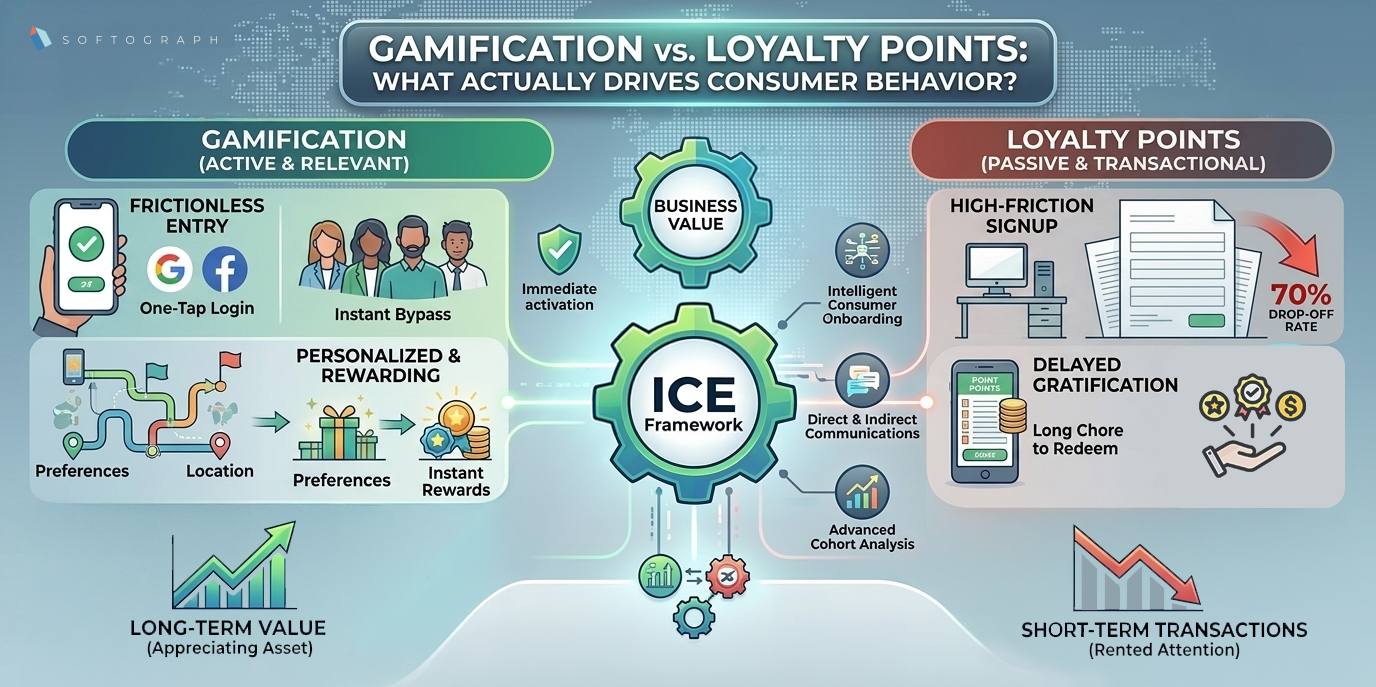
In an emerging market ecosystem, consumer behavior is defined by a demand for instant utility and immediate feedback. The structural flaw of the traditional loyalty points model is that it treats engagement as a long-term chore. A consumer buys a product, earns 50 points, and is told they can redeem a discount once they reach 5,000 points. This requires a level of patience that simply does not align with a fast-paced, smartphone-centric lifestyle.
Because points feel like a distant, abstract currency, they fail to trigger a psychological dopamine loop. The app becomes shelfware, occupying valuable memory on a consumer’s device until it is inevitably uninstalled during the next storage cleanup.
True gamification operates on an entirely different psychological engine. Instead of dangling a distant financial carrot, it focuses on the active journey. By providing immediate micro-rewards, collection mechanics, and visual progression, interactive platforms turn an ordinary brand interaction into a daily habit. The value is generated during the experience itself, keeping the consumer inside your digital perimeter.
Dropping the Registration Wall: Why Frictionless Entry Wins the Market
The biggest point of failure for any digital marketing ecosystem happens before the consumer even sees a reward. It happens at the registration screen. In emerging regions, requiring a user to fill out a 20-field form, verify an email address, and memorize a complex password is the fastest way to kill your adoption metrics. High-friction onboarding kills consumer momentum.
If a consumer has to fight through your interface just to start interacting, they will migrate to a competitor who respects their time. To capture a fast-moving audience, the entry point must be invisible, secure, and instantaneous.
This critical onboarding bottleneck is exactly why forward-thinking companies are shifting toward modern framework architectures. By replacing rigid, outdated validation walls with seamless social logins and one-tap One-Time Password (OTP) verification, brands eliminate entry friction entirely. Once the barrier to entry drops to zero, consumer activation rates skyrocket, allowing your platform’s behavioral loops to engage users from the very first second.
The Power of Personalized, Multi-Channel Journeys
Once a consumer is inside your ecosystem, the next major hurdle is avoiding the “one-size-fits-all” trap. A university student in a major metropolitan hub interacts with brands in a completely different way than a small business owner in a rural district. Yet, traditional point systems treat both profiles identically, pushing generic discount notifications that feel like spam.
When brand communications feel irrelevant, users mute notifications. Immersive consumer engagement platforms solve this by mapping unique, adaptive user pathways across multiple digital channels.
Dynamic Storytelling: Tailor the brand message to match the specific cultural and lifestyle preferences of different regions.
Contextual Challenges: Deliver interactive milestones based on real-time factors such as location, time of day, and historical purchase habits.
Multi-Channel Synchronization: Ensure the user’s interactive progress flows seamlessly across mobile apps, web portals, and physical retail touchpoints.
By transforming a rigid marketing funnel into an active, personalized sandbox, you allow consumers to dictate how they explore your brand. This level of autonomy builds an emotional connection that standard transaction slips can never replicate.
From Play to Predictive Data: The ICE Framework by Softograph
Moving past shallow vanity metrics requires a foundational technology engine capable of translating human actions into predictable business value. This is where ICE (Interactive Consumer Engagement Platform), developed by Softograph, changes the enterprise landscape. Softograph engineered ICE specifically to bridge the gap between behavioral psychology and rigorous corporate data analytics.
ICE dismantles the traditional loyalty model by deploying an intelligent ecosystem that optimizes every stage of the user lifecycle.
The platform addresses the critical realities of modern consumer behavior through three core technical capabilities:
Intelligent Consumer Onboarding: ICE eliminates registration friction at the front gate by leveraging advanced multi-method authentication and smart social syncs to ensure instant, high-volume user adoption.
Direct and Indirect Brand Communications: The platform embeds your corporate messaging directly into the interactive mechanics, allowing your business to educate, influence, and connect with your audience without disrupting their experience.
Advanced Cohort Analysis: ICE tracks real-time, interactive choices, voluntary decisions, and preference data, and runs sophisticated backend clustering to group users into highly accurate behavioral cohorts for ultra-targeted marketing re-engagement.
Winning the Real-Time Market
The emerging market consumer is not looking for another digital punch card to store in an overloaded mobile wallet. They are looking for dynamic, engaging, and frictionless digital experiences that offer immediate value.
Relying on legacy transactional loyalty points is an expensive way to rent short-term attention. By deploying a comprehensive framework like Softograph’s ICE, your business stops chasing empty transactions and begins building an appreciating behavioral data asset. The future of consumer loyalty belongs to the brands that know how to turn passive buyers into active participants. It is time to retire the scoreboard and build an interactive engine that drives sustainable, long-term market share.