
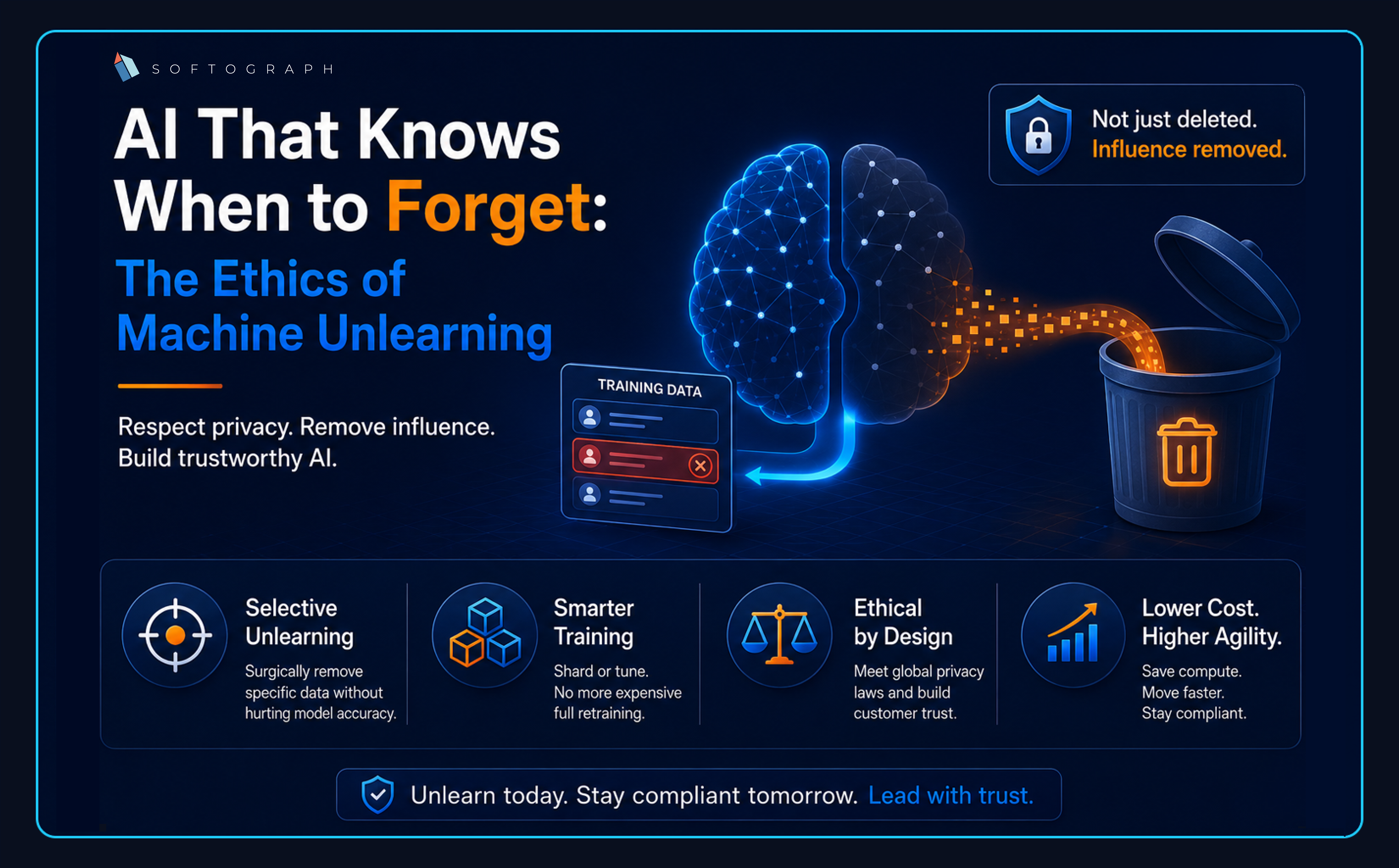
AI That Knows When to Forget: The Ethics of Machine Unlearning
Your AI remembers everything you taught it, even the things you desperately wish it would forget.
For years, corporate data management followed a simple rule: if a user invokes their “right to be forgotten,” you delete their record from the database. But in the era of generative AI and massive corporate LLMs, that rule is officially broken. When you train an AI model on customer data, that data isn’t just stored; it is chemically bonded into the model’s weights and parameters. Simply scrubbing the original training file does absolutely nothing to the model itself. The AI can still hallucinate, leak, or reconstruct the very information you thought you destroyed.
This creates a massive compliance blind spot for local enterprises. Regulators are waking up, and the traditional “delete” button is no longer enough. Enter machine unlearning: the next frontier of enterprise data compliance.
The Retraining Trap: Why Deleting Data Fails in AI Architectures
When a customer asks a local bank or healthcare provider to erase their data, compliance teams usually rush to clean their active databases. They think the job is done. It isn’t. If that data was used to train a custom customer service bot or a predictive risk model, it is still very much alive.
A parallel exists in traditional corporate software development: if an unauthorized piece of code is discovered deep within a monolithic legacy application, developers often face a logistical nightmare. However, while traditional software can be patched or refactored line by line, a neural network organizes its data through billions of interconnected numerical weights. Removing a single data stream without a targeted mechanism forces organizations into an all-or-nothing scenario: either accept the compliance risk or absorb the staggering costs of a complete retraining cycle.
For a small startup, retraining might cost a few hundred dollars. For a regional enterprise, retraining a custom model costs tens of thousands of dollars in compute time, delays product rollouts, and burns precious engineering hours. It is an unsustainable, expensive, and clumsy way to handle privacy.
Decoding the Tech: How Unlearning Works
Machine unlearning is the algorithmic equivalent of selective amnesia. It allows developers to surgically remove the influence of specific training data points without damaging the model’s overall intelligence or accuracy.
Engineers are tackling this using two primary methods:
- Sharded Training (SISA): If a user requests data removal, a specific shard containing that user’s data is removed, rather than the entire model.
- Influence Tuning: This uses advanced statistics to precisely quantify how much a specific data point shifted the model’s weights.
The goal is simple: achieve the exact same model state as if the deleted data had never existed, but at a fraction of the cost and time.
Algorithms on Trial: Why “Deleted” Is No Longer Compliant
Regulators around the world are changing the rules of data privacy. Global frameworks like the EU AI Act and updated international privacy laws no longer just look at where companies store data. They now look at how AI models use and retain that data over time.
Consider a high-stakes scenario: a multinational enterprise complies with a strategic client’s right-to-erase request by wiping their servers. Months later, that same enterprise’s proprietary LLM produces output clearly derived from the client’s intellectual property during a competitive bid. The result is a corporate disaster. This is no longer a standard data leak; it is an enforcement action for non-compliant AI governance. The legal liability shifts from simple operational negligence to structural algorithmic non-compliance, an offense that carries devastating global fines and catastrophic reputational damage.
In a global market, consumer trust is a fragile but critical currency. Brands that can verifiably prove their AI systems respect privacy boundaries will capture the market. Machine unlearning transforms global compliance from an expensive legal burden into a powerful competitive advantage.
A Practical Roadmap for Tech Leaders
Implementing machine unlearning requires a proactive shift in how we build software. You cannot treat AI governance as an afterthought or a compliance checklist item at the end of a sprint. It must be baked into your architecture from day one.
Achieving algorithmic agility requires a three-pronged operational shift:
- Trace the Data Lineage: Compliance and engineering teams must map exactly which data streams feed into specific model weights. Without precise tracking, surgical data removal becomes impossible.
- Deconstruct the Monolith: Avoid massive, single-block AI models. Adopting modular architectures and data sharding allows teams to isolate pipelines and retrain tiny, specific fragments instead of burning compute on a full system rebuild.
- Audit for Leakage: Never assume a model has forgotten just because a patch was deployed. Organizations must stress-test live models against membership inference attacks to ensure that sensitive “deleted” data cannot be reverse-engineered or leaked.
The future belongs to agile enterprises that build flexible, compliant systems. By investing in machine unlearning now, you protect your company from future regulatory shifts, save significant compute costs, and build an AI ecosystem that truly respects customer boundaries.