
What FMCG Brands Get Wrong About Trade Marketing ROI
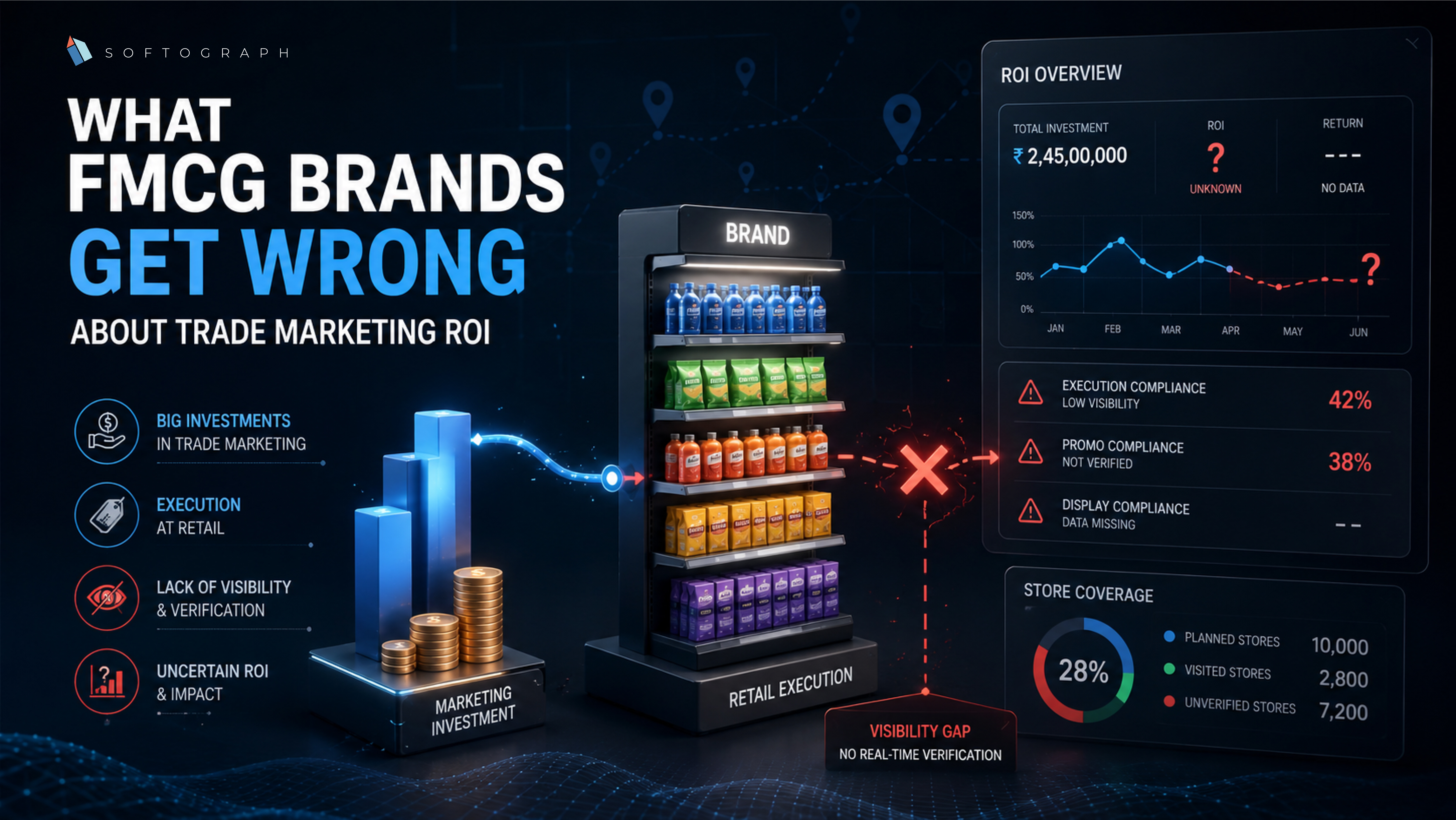
Every month, consumer goods companies pour vast budgets into trade marketing without any real proof that their displays ever make it onto the retail floor.
During high-stakes quarterly performance reviews, the tension in the boardroom is unmistakable. Brand teams confidently present beautiful slide decks detailing aggressive spending on modern trade activations, premium shelf real estate, and thousands of neighborhood store posters. But the moment leadership asks for an absolute, real-time link between those investments and actual store-level compliance, the conversation stalls.
For FMCG executives fighting to protect margins across chaotic distribution channels, this visibility gap is a costly operational trap. Instead of driving measurable retail volume, brands find themselves flying blind, relying on delayed, self-reported field logs that only flag execution failures weeks after the opportunity has passed.
The Blind Investment Trap
Traditional trade marketing operates on an incredibly delayed feedback loop. Brands pour substantial capital into premium in-store merchandising, planogram compliance, and promotional discounts, yet lack an immediate mechanism to verify compliance at the point of sale.
The standard process relies heavily on manual field reporting. Field forces navigate complex retail routes, manually filling out paper forms or entering subjective notes into basic tracking applications. By the time these reports are compiled, reviewed, and pushed up to corporate headquarters, weeks have passed. If a premium display was never set up, or if stock remained trapped in the backroom during a peak promotional weekend, leadership only finds out long after the campaign has ended.
This structural visibility gap turns trade marketing into an expensive guessing game. Brands routinely pay for premium shelf placement that retailers fail to maintain, thereby actively subsidizing execution failures. Without a way to instantly verify store-level execution, calculating a true return on investment (ROI) becomes impossible.
Execution Across Fragmented Trade Channels
Our local retail landscape operates on its own set of rules. While consolidated global markets rely on a handful of massive supermarket chains, our ecosystem is a sprawling, chaotic mix of modern trade outlets and hundreds of thousands of independent mom-and-pop stores.
Trying to manage product execution across this massive, decentralized network creates constant operational friction. Distribution hiccups, localized stockouts, and inconsistent merchant compliance erode brand profitability every single day. If your product drops off a neighborhood shelf for even a single afternoon, consumers won’t wait; they will simply buy whatever competitor is within arm’s reach, resulting in an immediate, unrecoverable loss of revenue.
Your trade strategy is only as strong as your least compliant retail route. If you cannot spot a shelf-level execution failure right when it happens, you are actively giving away market share to more agile brands.
Local consumer goods enterprises can no longer afford to run their operations through slow, backward-looking spreadsheets. Relying on monthly sales wrap-ups or delayed regional summaries to evaluate your trade marketing effectiveness leaves your brand entirely exposed to rapid on-the-ground shifts, proving that traditional, manual audit methods are completely obsolete.
Shifting to Real-Time Retail Auditing
Eliminating this massive financial leak requires a complete technological overhaul. Forward-thinking consumer goods companies are abandoning slow, manual oversight and adopting automated, data-driven systems that offer an unfiltered view of the retail shelf.
This shift in auditing speed transforms how brands evaluate their retail presence. While traditional trade audits require weeks of manual data compilation, leaving leadership reacting to old news, an automated infrastructure streams instant, real-time data directly from the field.
Furthermore, modern architecture replaces self-reported, unverified check-ins with verified, role-based geo-tracking, ensuring field forces are exactly where they need to be. By eliminating the high risk of human error or reporting bias inherent in legacy methods, real-time auditing delivers pure, objective store-level truth that you can confidently use to make immediate strategic adjustments.
Accelerating Field Velocity with Trade Eye
True retail optimization isn’t a data collection contest; it’s about orchestrating flawless movement in the market. When field sales representatives are left to navigate their own territories, they waste critical hours battling traffic instead of building relationships with store managers.
Trade Eye eliminates this operational friction by embedding intelligent, role-based geo-tracking and dynamic route optimization directly into its core engine. The platform automatically maps out the most efficient physical paths for your field teams, maximizing daily store coverage while slashing windshield time.
A Two-Way Solution for Field and Office
- For the Field Force: Reps receive clear, automated daily schedules paired with rapid digital audit tools that completely eliminate administrative paperwork.
- For Head Office: Leadership gains real-time, unvarnished visibility into route compliance, time-at-shelf metrics, and live execution data.
By transitioning your team into an objective digital ecosystem, you liberate them from tedious manual reporting. Instead, every action on the ground is automatically validated, while immediate insights flag distribution gaps in real time, ensuring every trade marketing dollar is precisely targeted for maximum ROI.
Driving Continuous Retail Growth
The traditional practice of throwing money at trade promotions and hoping for the best is a fast track to eroded margins. In an increasingly competitive, fast-moving consumer goods market, true profitability belongs to the brands that control their retail execution with absolute precision.
Trade Eye by Softograph represents the necessary transition from blind investments to data-driven retail execution. By automating store audits, validating field movements, and delivering instant, unfilterable operational clarity, the platform empowers FMCG leaders to stop guessing and start scaling.
Stop letting hidden retail execution failures drain your marketing budgets. Discover how to transform your store-level execution into a highly precise, high-yield growth engine by visiting https://softograph.com/trade-eye today.