
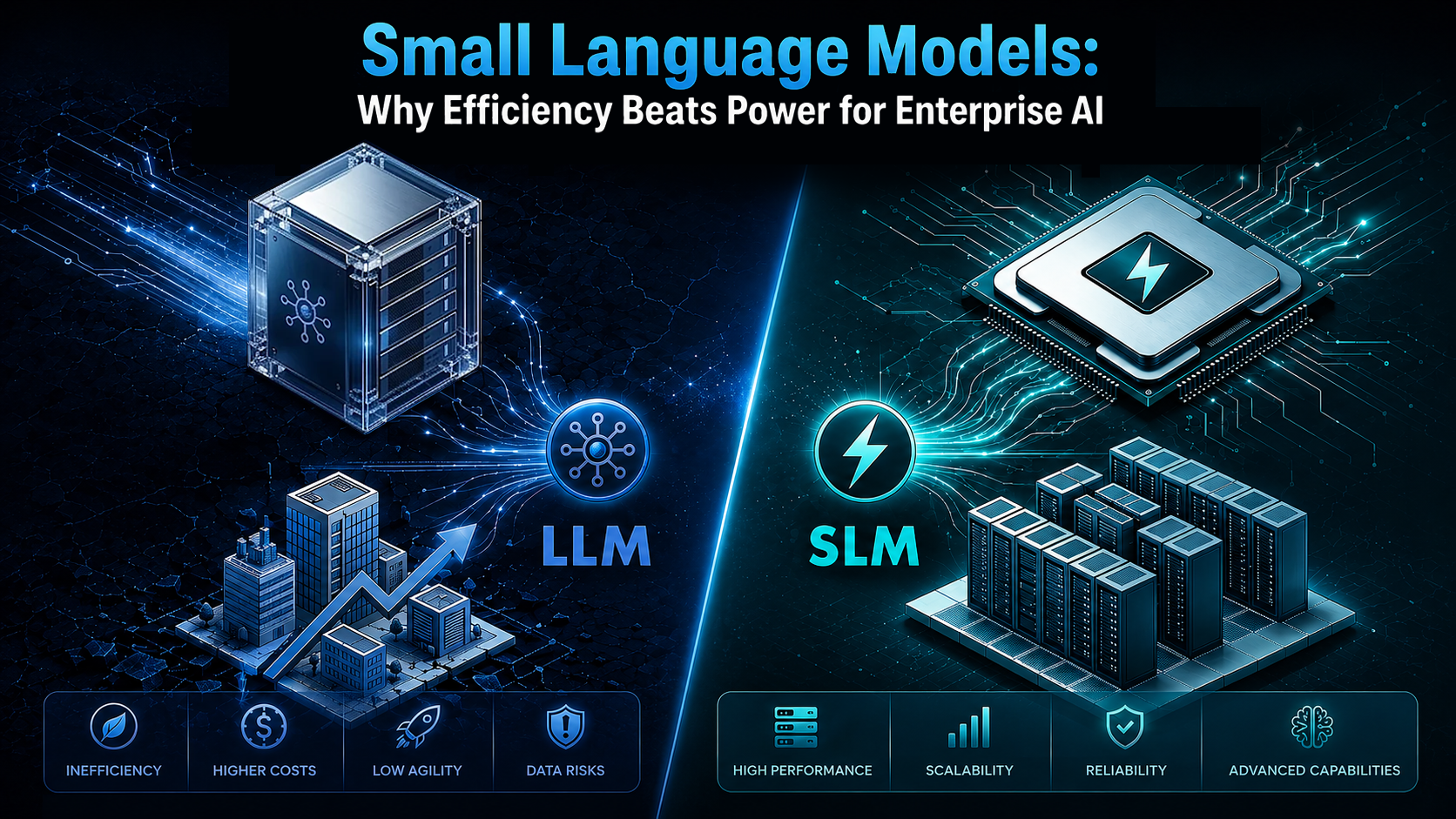
Small Language Models: Why Efficiency Beats Power for Enterprise AI
The corporate obsession with massive AI model parameters has created a costly blind spot for enterprise leaders. For the past several years, the prevailing narrative in boardroom discussions has been simple: bigger is always better. Companies rushed to adopt trillion-parameter Large Language Models (LLMs), assuming that raw computational power would automatically translate into business value.
That assumption is crumbling under the weight of reality.
Deploying a massive, multi-purpose AI model to handle a specific, structured corporate task is the operational equivalent of using a commercial jetliner to deliver a pizza. It is inefficient, needlessly expensive, and operationally reckless. As organizations move from AI experimentation to production, the focus is shifting away from brute force toward precision. Small Language Models (SLMs) are emerging as the pragmatic, high-performance alternative for the modern enterprise.
Paying for Power You Don’t Need
Operating massive language models requires an immense amount of capital, cloud infrastructure, and specialized hardware. Every single query processed by a trillion-parameter model triggers a cascade of computational expenses. For a regional enterprise handling millions of daily operational tasks, these API fees and cloud compute costs quickly become unsustainable.
The core issue stems from paying for unutilized capabilities. A standard LLM contains vast amounts of generalized knowledge, from historical trivia to creative writing skills. While impressive, this broad knowledge base is entirely irrelevant to a corporate data pipeline. When an enterprise uses a massive model to extract entities from an invoice or summarize a contract, it pays for the computational overhead of the entire model. The business is essentially paying for the parts that write poetry or translate dead languages.
SLMs eliminate this financial waste. By stripping away extraneous data and focusing strictly on core linguistic structures, these models operate with a fraction of the parameters, often ranging from 1 to 7 billion. This architectural efficiency means they can run on standard enterprise hardware or modest cloud instances. The result is a dramatic reduction in the total cost of ownership, allowing companies to scale their AI initiatives without incurring exponential infrastructure costs.
Redefining Speed and Data Sovereignty
In enterprise operations, latency is a silent killer of user adoption. When an internal team or an external customer interacts with an AI system, they expect near-instantaneous responses. Massive models, by their very nature, introduce significant latency. The sheer volume of data passing through their neural networks creates processing bottlenecks, especially during peak operational hours when public cloud servers are congested.
SLMs rewrite the rules of operational speed. Because of their lightweight architecture, their inference times are exceptionally fast, processing queries in milliseconds rather than seconds. This speed makes them ideal for real-time applications, such as live customer support bots, automated trading assistants, or field operations tools where delayed information is useless.
Beyond speed, SLMs solve the pressing challenge of data security and sovereignty.
Using a public, cloud-hosted LLM requires sending proprietary corporate data outside the company’s secure perimeter. For highly regulated industries, such as banking, or enterprises operating within the strict data compliance frameworks, this approach poses unacceptable compliance risks and potential data leaks.
This is precisely why we engineered Data Dialogue, Softograph’s flagship Retrieval-Augmented Generation (RAG) and Natural Language solution, to leverage highly optimized, specialized models. SLMs are small enough to be deployed locally on-premise or within a private corporate cloud. This private deployment ensures that sensitive customer records, intellectual property, and financial data never leave the organization’s secure infrastructure. Enterprises retain absolute control over their data footprint, completely insulated from third-party vulnerabilities or shifting vendor terms.
Small Models, Expert Answers
A common misconception is that a smaller model is inherently less accurate. In reality, a highly focused, smaller model routinely outperforms a generalized giant when applied to a specific corporate domain. Generalized LLMs are prone to “hallucinations”, generating confident but entirely inaccurate assertions, because they are trying to synthesize vast, conflicting subsets of the public internet.
Enterprise AI does not need to know everything; it needs to know your business perfectly.
When an SLM is integrated into a secure RAG framework like Data Dialogue and tuned on a company’s internal datasets, such as proprietary product manuals, historical customer tickets, or specific legal compliance frameworks, it becomes a specialized expert. It learns the unique vocabulary, acronyms, and operational logic of that specific business. Because its focus is narrow, its accuracy within that domain skyrockets, while the risk of hallucination plummets.
This specialization changes how companies approach workforce enablement. Instead of relying on a single, massive, unreliable AI system to handle every corporate function, forward-thinking enterprises are deploying networks of specialized SLMs. One model manages HR compliance, another handles contract analysis, and a tool powered by Data Dialogue queries complex business intelligence data. Each runs efficiently and securely, at a fraction of the cost of a monolithic system.
Efficiency as the Ultimate Strategy
The narrative surrounding enterprise AI is maturing. The initial awe of generalized generative AI is giving way to a disciplined focus on return on investment, operational reliability, and data control. The companies winning the next phase of digital transformation are not those with the largest models, but those with the most efficient architectures.
Shifting toward Small Language Models is not a compromise on capability; it is a strategic optimization. By prioritizing task-specific efficiency over generic power, enterprises can finally build AI systems that are financially sustainable, lightning-fast, entirely secure, and deeply aligned with their core business objectives. The era of AI brute force is ending. The era of the precise, purposeful enterprise model has arrived.