
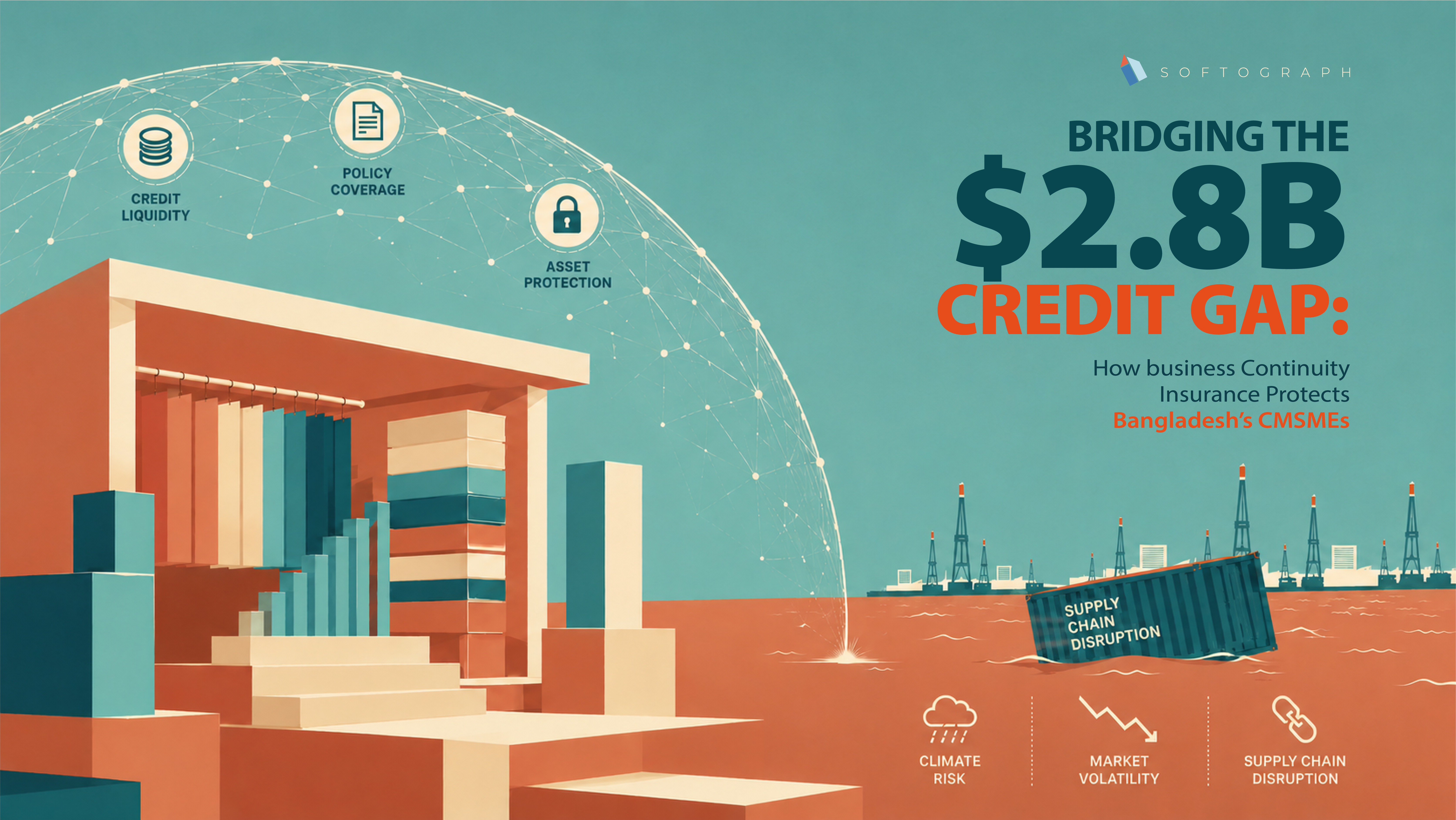
Bridging the $2.8B Credit Gap: How Business Continuity Insurance Protects Bangladesh’s CMSMEs
For most businesses, a fire, an early monsoon, or a few extra weeks of supply disruption is a setback to manage. For Bangladesh’s cottage, micro, small, and medium enterprises, it can be the end of the business altogether, because the inventory on the shelves is often the entire invested capital, financed by debt that does not pause just because the shop is gone.
Dhaka’s Bangabazar fire in April 2023 made this dynamic impossible to ignore [1]. It was not a freak event so much as a preview of what happens, over and over, to a sector that carries a quarter of the national economy on its back with almost no financial shock absorber underneath it.
The shock absorber it is missing has a name: business continuity insurance, sometimes called business interruption (BI) cover.
The number everyone quotes, and where it actually comes from
The $2.8 billion figure has become shorthand for Bangladesh’s SME financing problem, but it is worth being precise about its origin. It traces back to the International Finance Corporation (IFC), a member of the World Bank Group, and was popularised at a November 2023 conference in Dhaka co-hosted by IFC and Bangladesh Bank with support from the Norwegian government [2,3] IFC pegged the country’s MSME financing gap at $2.8 billion, noting that nearly 10 million SMEs contribute roughly a quarter of GDP [2]. The estimate has been repeated in policy discussions and press coverage ever since, including in a 2026 Daily Star analysis that still cites IFC as the source, a sign that no newer estimate has replaced it. [4]
What rarely gets asked is why the gap persists despite years of refinance schemes, low-interest quotas, and a national Credit Guarantee Scheme. A recent Daily Star analysis offers the sharpest answer yet: banks are still built to evaluate a factory, not a footpath shop, because their credit-rating architecture depends on physical collateral and formal documentation that most CMSMEs simply do not have. [4]
That collateral-first model does something else, too. It makes every loan a bet purely on the borrower’s ability to survive whatever the next flood, fire, or currency shock throws at them, because nothing else is absorbing that risk. This is where insurance enters, not as a nice-to-have, but as the missing layer between “creditworthy on paper” and “creditworthy in a country that floods every year.”
Why lenders quietly price in disaster, and CMSMEs pay for it
Bangladesh is one of the most disaster-exposed economies in the world, and 2024 offered a brutal case study. Heavy rainfall combined with an upstream water surge from Tripura submerged 73 upazilas across 11 districts, killed 71 people, and caused an estimated Tk 144 billion (about $1.2 billion) in property damage.[5] In Feni, one of the hardest-hit districts, over 90% of the population was affected, and nearly half of homes were destroyed, according to an Oxfam assessment.[6,7] Oxfam’s country director summed up the scale of it plainly, saying the floods had wiped out livelihoods for lakhs of people. Among the ordinary businesses lost was the case of a flood victim in Chagalnaiya upazila, whose small vegetable shop, his family’s only source of income, was completely destroyed. [7]
A vegetable stall, a tailoring shop, a small workshop: these are the CMSMEs that make up roughly a quarter of Bangladesh’s GDP and employ the vast majority of its non-agricultural workforce. When disaster wipes out their inventory or premises, there is almost never a payout waiting on the other end. Insurance simply has not reached this part of the economy; Bangladesh’s insurance penetration is among the lowest in the region, and the category that would actually cover fire, flood, and business interruption is thinner still. The country has been called the most underinsured in the world for exactly this kind of risk.[8]
Put those two facts side by side, and the credit gap stops looking like a lending problem and starts looking like a risk-transfer problem. Banks are not just reluctant to lend to small, undocumented businesses; they are reluctant to lend to uninsured businesses operating in a disaster corridor, because a single flood season can erase the collateral the loan was written against. Business continuity insurance breaks that logic by absorbing the shock the lender is really pricing in.
What business continuity insurance actually changes
Business continuity or business interruption insurance does not just rebuild a shop after a fire; it replaces the income the business would have earned had the disruption never happened, covering fixed costs, payroll, and lost revenue during the recovery window. For a CMSME, that is often the difference between reopening and disappearing, because, as Bangabazar’s traders discovered, the destroyed inventory was frequently the entire invested capital of the business, financed by debt that did not pause just because the shop had burned down. [9]
The UNDP has argued this is not a peripheral product but a missing link in global protection for small businesses, estimating that as little as $10–15 a day of interruption coverage over a six-month recovery period can be the difference between survival and closure, and naming Bangladesh as one of ten priority countries for scaling this model to more than 170 million MSMEs worldwide. [10]
Crucially, business continuity insurance does not have to mean traditional, paperwork-heavy commercial policies designed for large factories. Bangladesh already has a working template for something leaner: parametric, index-based insurance. Green Delta Insurance, in partnership with the World Food Programme, Oxfam Bangladesh, and technical partners, built a flood-index product using nineteen years of satellite data that pays out automatically once flooding crosses a predefined threshold, no adjuster visit, no lengthy claims investigation. During the 2020 monsoon, the trigger fired and enrolled households received payouts of up to roughly $212 within the season, distributed via mobile money .[11]. The same underlying approach, weather and satellite triggers instead of manual loss assessment, has already been extended to more than 25 crop-specific products for Bangladeshi farmers.
There is no structural reason that model stops at agriculture. A shopkeeper in a flood-prone char, a workshop owner in a fire-prone tin-shed market, or a garment subcontractor exposed to both could be covered by the same trigger logic: water level crosses a threshold, or a fire service report confirms a blaze, and a predetermined payout releases automatically. For CMSMEs that cannot survive months of claims paperwork, speed is not a convenience; it is the entire value proposition.
The policy window is already open
The country’s regulators appear to have reached the same conclusion. In January 2026, the SME Foundation, under the Ministry of Industries, and UNDP launched the Insurance Innovation Challenge, a competitive grant facility explicitly designed to fund regulator-approved, technology-driven, gender-responsive insurance products built for CMSMEs, with winners receiving grants of up to Tk 4.86 million [12]. UNDP’s resident representative in Bangladesh framed the urgency starkly, describing floods, cyclones, and droughts as recurring stresses rather than isolated events, ones that destroy assets and disrupt entire families in the same breath that they shut down small businesses.
This is where the credit gap and the insurance gap finally meet. Bangladesh Bank’s existing Credit Guarantee Scheme (CGS), developed with IFC support, was built to make banks more comfortable lending to first-time, collateral-poor borrowers. IFC’s own impact study found that CGS-backed lending measurably increased first-time borrowing and loan sizes for women-owned micro and small enterprises. Layer business continuity insurance underneath that same guarantee architecture, and lenders gain a second line of defence: not just a government guarantee if a borrower defaults for ordinary reasons, but a mechanism that reduces the odds a flood or a fire forces that default in the first place.
The uncomfortable arithmetic
Here is the number worth sitting with: UNDP estimates that providing business interruption cover to the 65 million-plus MSMEs globally who currently lack access to credit would cost around $1.63 billion a year, worldwide [10]
Bangladesh’s own credit gap is $2.8 billion. The insurance layer that could meaningfully de-risk a large share of that gap is, in relative terms, cheap. What has been missing is not the economics; it is the distribution, the last-mile machinery to price, sell, and pay out policies to a vegetable seller in Feni as readily as to a garment exporter in Dhaka. [2]
Bangabazar’s traders did not lose their businesses because they were bad borrowers or bad entrepreneurs. They lost them because there was no product standing between a lit cigarette and a decade of accumulated stock. Bridging the $2.8 billion credit gap will take refinance schemes, better credit-rating models, and cash-flow-based lending, as ongoing reform efforts already recognise. But none of that will hold if the next flood season or the next market fire is still able to erase a business overnight, with nothing to catch it on the other side.
References
- The Business Standard, Micro, small, medium enterprises in Bangladesh face a financing gap of $2.8 billion
- IFC, IFC and Bangladesh Bank Host Conference to Ramp Up SME Financing in the Country
- The Daily Star, Why small businesses remain invisible to traditional credit ratings
- The Business Standard, Over 90% of people in Feni, Noakhali affected by floods: Oxfam
- The Business Standard, Why insurance penetration in Bangladesh remains low and what must change
- The Daily Star, One year since Bangabazar fire: Now a shadow of its former self
- The Business Standard, Bangabazar fire: Makeshift shops fail to satisfy cash-strapped traders
- UNDP, Business continuity insurance; a missing link in global protection
- World Food Programme , How flood insurance empowers people facing extreme weather in Bangladesh
- Green Delta Insurance, Best Agriculture Insurance in Bangladesh
- The Business Standard, SME Foundation, UNDP launch insurance innovation challenge
- Tk303cr financial loss estimated in Bangabazar fire